Intersphincteric groove (Latin: sulcus intersphinctericus)
Also called the intersphincteric line or the anal intersphincteric groove
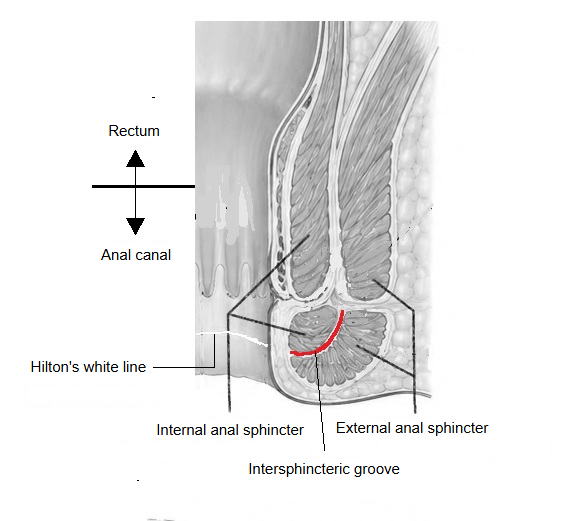
The intersphincteric groove is the groove in the lower part of the anal canal between the internal anal sphincter and the external anal sphincter.
Anal canal: the last part of the digestive tract, ending at the anusInternal anal sphincter: smooth muscleExternal anal sphincter: striated (skeletal) muscle
The intersphincteric groove runs round the canal near the anus and lies at about the level of Hilton's white line.
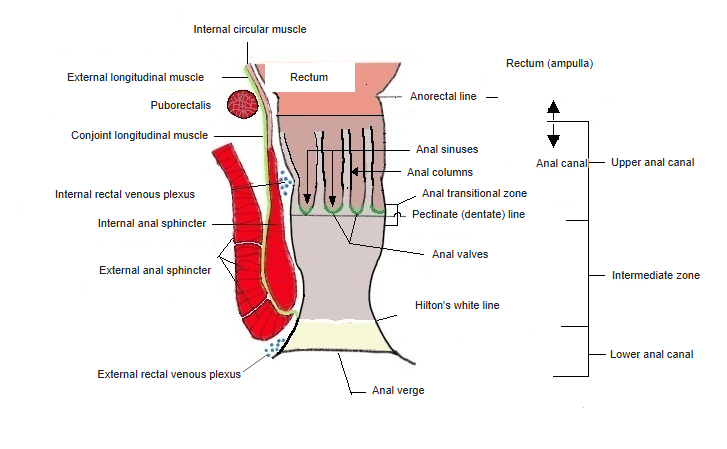
Hilton's white line: the boundary between the intermediate zone and the lower anal canal (the anal canal is divided into three zones)
The internal sphincter (smooth muscle) ends a little above the subcutaneous part of the external sphincter (skeletal muscle); the groove marks the gap between them and can be felt with a finger in the anal canal. Many sources treat it and Hilton's white line as the same landmark. Sources differ on its exact level; it is usually placed about 1 cm or less above the anal verge.
Divisions
of the
anal canal
of the
anal canal
- Upper anal canal
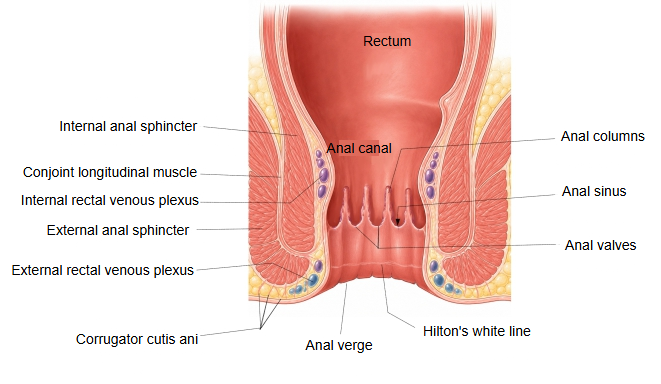
(anal column zone) : from the anorectal line to the pectinate line; about 1.5–2 cm. Lined by simple columnar epithelium continuous with the rectal mucosa. Here are the anal columns, anal sinuses and anal valves. - Intermediate zone
(transitional zone) : from the pectinate line to Hilton's white line; about 1–1.5 cm. The lining changes to stratified squamous epithelium; in places columnar and stratified squamous epithelium lie side by side. A venous plexus is well developed beneath the mucosa. - Lower anal canal
(skin zone) : from Hilton's white line to the anal verge; a few millimetres to 1 cm. Covered by stratified squamous epithelium rich in melanin pigment. It ends at the anus, whose margin is the anal verge; sweat glands are found here.
Related terms
References and sources
- Further reading: Anal canal, Wikipedia.
- Further reading: Pectinate line, Wikipedia.
- Federative International Programme for Anatomical Terminology (FIPAT). Terminologia Anatomica, 2nd ed. (TA2), 2019.