Portal tract
Also called the portal canal or the portal area
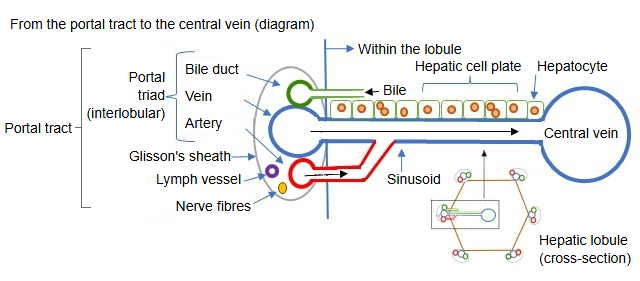
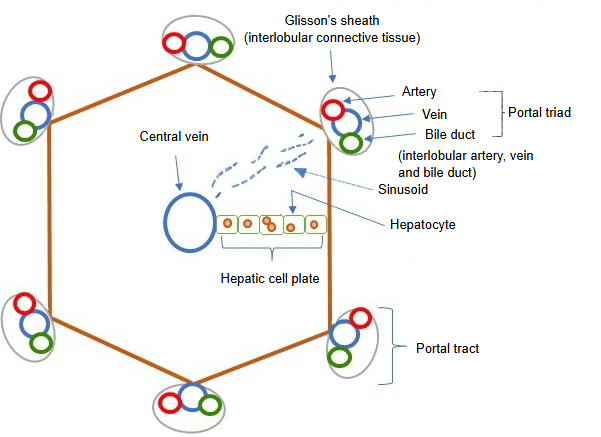
The portal tract is the area at each corner of the hepatic lobules, surrounded by Glisson's sheath, that contains the portal triad, nerves and lymph vessels.
Hepatic lobule: the unit of liver cells of the liverGlisson's sheath: the connective tissue that covers the whole liver and continues into it (interlobular connective tissue)Portal triad: the interlobular artery, the interlobular vein (a branch of the portal vein) and the interlobular bile ductLymph vessels: the liver produces a large share of the lymph of the body, and much of it drains through these vessels
· Blood from the portal tract flows into the sinusoids towards the central vein, while bile flows the other way, from the hepatic cell plates into the portal tract.
· 'Portal tract' describes the whole area, including its connective tissue; 'portal triad' refers to the three main tubes inside it. Some sources use the two names loosely.
Related terms
- Portal triad
- Glisson's sheath
- Interlobular connective tissue
- Hepatic lobule
- Interlobular bile duct
- Interlobular veins of the liver
- Liver
References and sources
- Further reading: Lobules of liver, Wikipedia.
- Federative International Programme for Anatomical Terminology (FIPAT). Terminologia Anatomica, 2nd ed. (TA2), 2019.