Interlobular bile duct (Latin: ductus biliferi interlobulares)
Also called the interlobular bile ductules
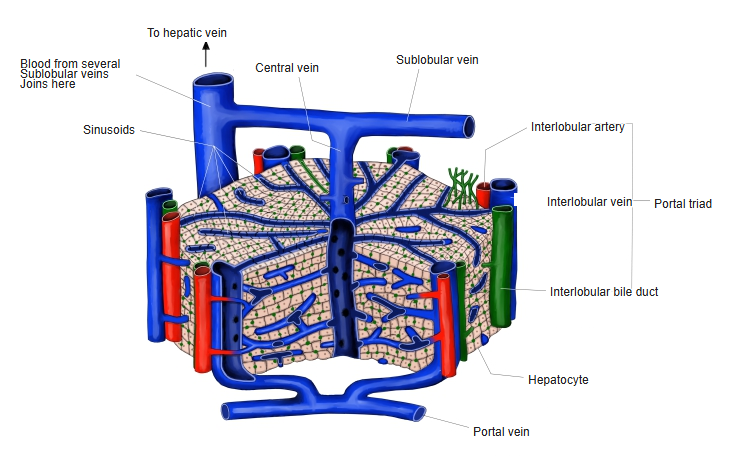
An interlobular bile duct is one of the three structures of the portal triad; it collects the bile made in the hepatic lobule through the bile canaliculi.
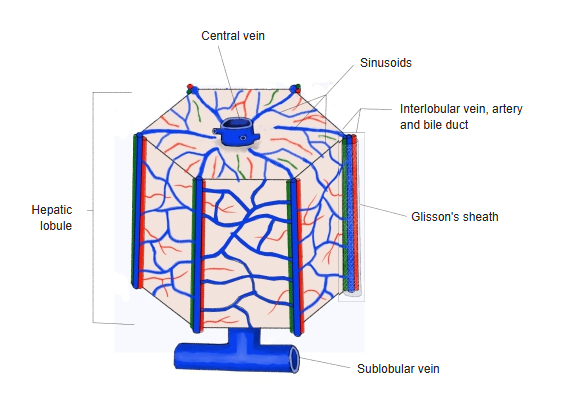
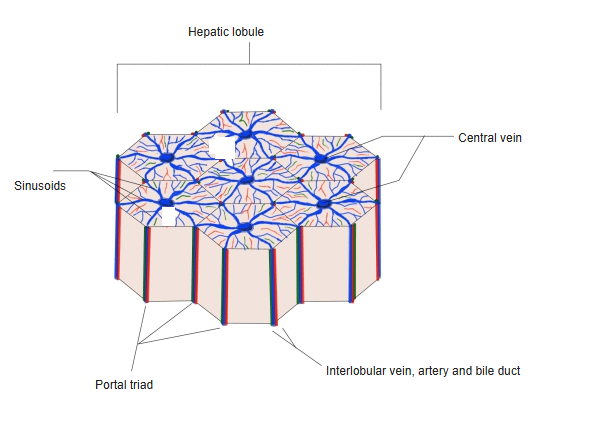
Between the hepatic lobules, the interlobular vein, artery and bile duct run together, wrapped in Glisson's sheath
· The bile collected by the interlobular bile ducts is finally carried to the gallbladder and stored there.
The bile pathway inside the liver
Hepatocytesecretes bile
in the hepatic lobule
Bile canaliculus0.5–1.5 µm
at the edge of the lobule
Canal of Heringabout 10–15 µm
Bile ductuleabout 10–15 µm
between the lobules
Interlobular bile ductabout 15–100 µm
in a hepatic segment
Segmental bile ductsabout 1–2 mm
order in some other sources
Sources differ: some do not distinguish the bile canaliculus, canal of Hering and bile ductule, some do not use the names bile ductule and canal of Hering at all, and some reverse their order. The diameters are only rough guides.
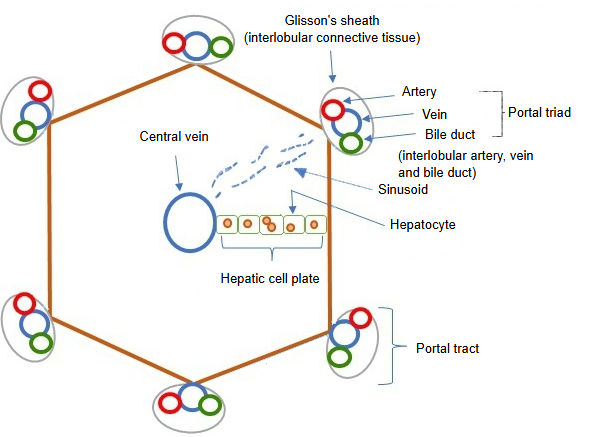
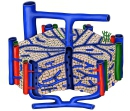 Structure of a hepatic lobule
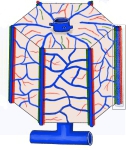 Hepatic lobule and vessels
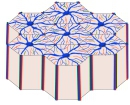 Hepatic lobules
Where it is found
Related terms
- Portal triad
- Interlobular connective tissue
- Interlobular veins of the liver
- Central vein of the liver
- Common hepatic duct
- Common bile duct
- Liver
References and sources
- Further reading: Lobules of liver, Wikipedia.
- Further reading: Bile duct, Wikipedia.
- Further reading: Canals of Hering, Wikipedia.
- Federative International Programme for Anatomical Terminology (FIPAT). Terminologia Anatomica, 2nd ed. (TA2), 2019.