Hepatocyte
Also called Liver cell or the parenchymal cell of the liver
- Overview
- Functions
- Other cells
- Reference websites
- (Wikipedia, websites with illustrations)
- Related terms
Overview
· The liver can be divided into the hepatic parenchyma and the hepatic stroma; the hepatocytes are the cells that make up the hepatic parenchyma.
of the
liver
- Hepatic parenchyma
- Hepatocytes : about 70–80% of the liver; about 250–300 billion cells. Polyhedral, about 20–30 µm across; many have two nuclei (about 30–40% by some estimates). Long-lived (several months to about a year) but able to multiply after injury. Arranged in rows, the hepatic cell plates, in each hepatic lobule. Functions: metabolism of nutrients, detoxification, synthesis of proteins, production of bile.
- Hepatic stroma
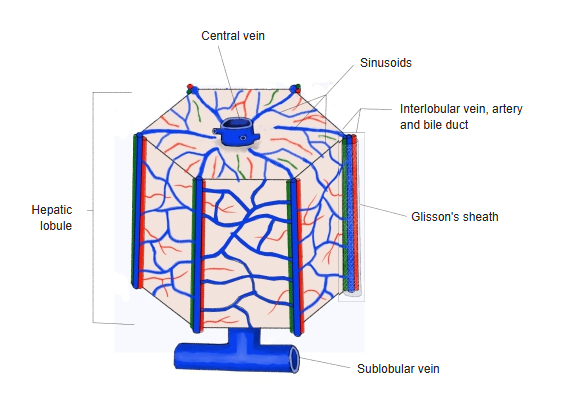
- Connective tissue : Glisson's sheath wraps the blood vessels and bile ducts that run through the liver.
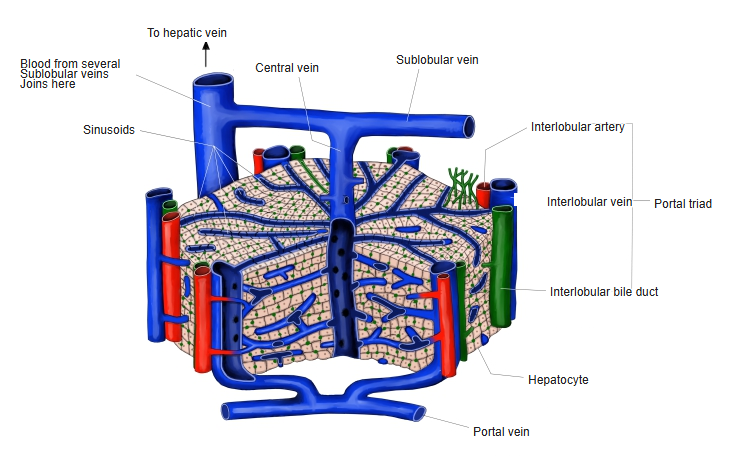
- Blood vessels : the portal vein and the proper hepatic artery; their blood mixes in the hepatic lobule and leaves through the hepatic veins into the inferior vena cava.
- Bile ducts : collect the bile made by the hepatocytes and carry it out of the liver: bile canaliculi, interlobular bile ducts and others.
- Lymphatic vessels : the liver produces more lymph than any other organ; lymph from the lobules flows along Glisson's sheath into the lymphatic vessels.
- Nerves : sympathetic fibres (from the coeliac plexus) and parasympathetic fibres (from the vagus nerve).
- Non-parenchymal cells : Kupffer cells, hepatic stellate cells, sinusoidal endothelial cells, cholangiocytes and others.
· Some estimates say that it takes about one to two years for the hepatocytes of the whole liver to be replaced.
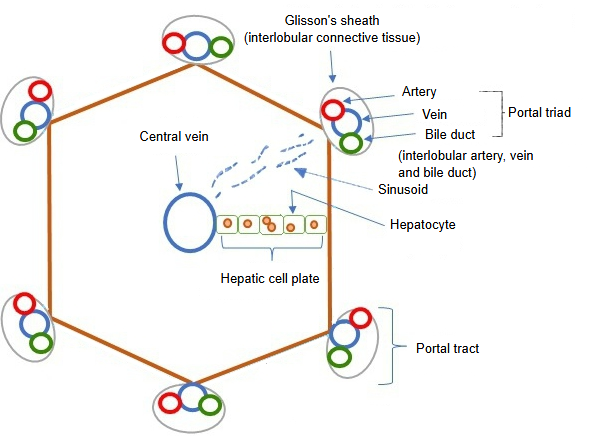
 Structure of a hepatic lobule
 Hepatic lobule and vessels
Functions
1. 1. Metabolism
Hepatocytes process, store and convert the nutrients absorbed from food (carbohydrate, fat and protein).
Conversion: for example, glucose is turned into glycogen and stored.
2. 2. Detoxification
They break down harmful substances such as alcohol, drugs and ammonia (which is turned into urea) and make them harmless.
3. 3. Production of bile
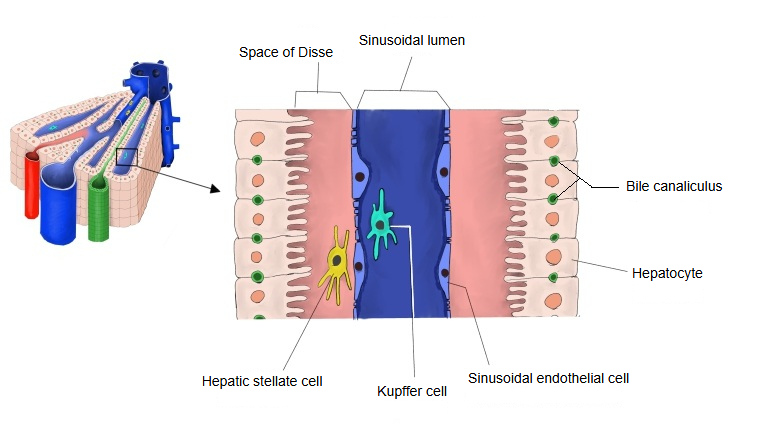
They make bile from cholesterol (bile acids) and bilirubin (a breakdown product of haemoglobin) and secrete it into the bile canaliculi; the bile is then carried to the gallbladder.
4. 4. Synthesis of blood components
They make plasma proteins such as albumin, fibrinogen and most of the clotting factors.
Other cells
The hepatocytes are the main cells of the liver, but the liver also contains the following cells.
| Name | Description | |
|---|---|---|
| 1 | Kupffer cells | Macrophages of the liver that lie in the sinusoids and engulf foreign material, bacteria and worn-out red blood cells. Roughly 15% of the liver's cells by some estimates. |
| 2 | Hepatic stellate cells | Also called Ito cells; they lie between the sinusoids and the hepatocytes, in the space of Disse, and store vitamin A. |
| 3 | Sinusoidal endothelial cells | Line the sinusoids. Unlike ordinary endothelium, the lining is not continuous: it has many small pores (fenestrations) and no continuous basement membrane. |
| 4 | Cholangiocytes | Epithelial cells that line the bile ducts |
| 5 | Others | Immune cells (T cells, NK cells and others), liver progenitor cells, fibroblast-like cells, and the endothelial cells of the portal and arterial vessels |
 Hepatocytes in the hepatic lobule
 Surroundings of a sinusoid
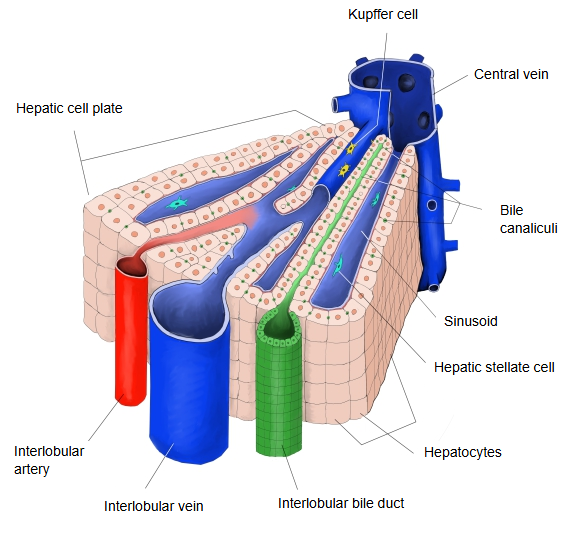
Reference websites
[Wikipedia]
· Hepatocyte, Wikipedia.
· Liver, Wikipedia.
[Websites with illustrations]
· Hepatocyte cell structure (diagram) (Dreamstime)

· Hepatic lobule and cells (figure) (Gastroenterology)

Related terms
- Hepatic cell plate
- Hepatic parenchyma
- Hepatic lobule
- Sinusoid
- Canal of Hering
- Portal triad
- Central vein of the liver
- Liver
References and sources
- Further reading: Hepatocyte, Wikipedia.
- Further reading: Liver, Wikipedia.
- Federative International Programme for Anatomical Terminology (FIPAT). Terminologia Anatomica, 2nd ed. (TA2), 2019.