Glisson's sheath (Latin: capsula fibrosa perivascularis)
Also called Perivascular fibrous capsule
and its
membranes
- Surface
- Glisson's capsule : a connective tissue membrane covering the whole surface; it contains a few cells, nerves and other structures.
- Peritoneum : covers the surface except some parts (the porta hepatis, the bare area and the area in contact with the gallbladder); a serous membrane.
- Liver parenchyma
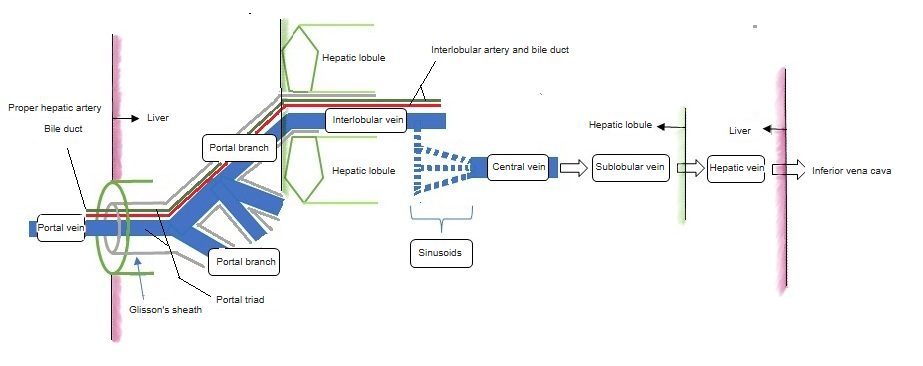
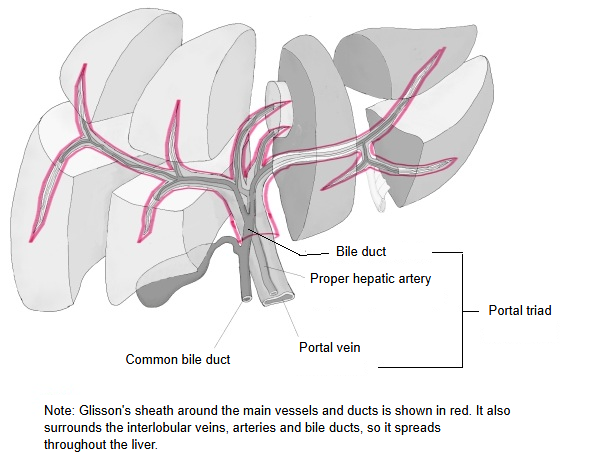
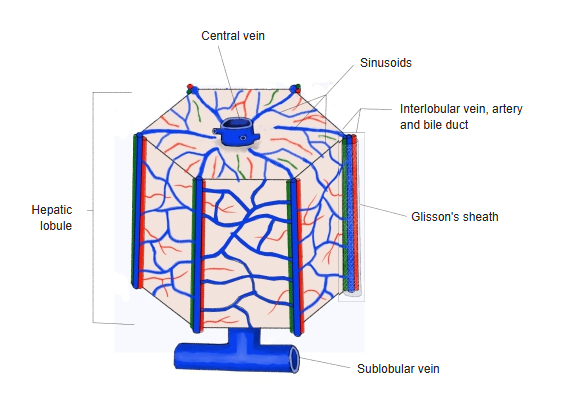
- Glisson's sheath : the continuation of Glisson's capsule; from the porta hepatis it wraps the arteries, veins and bile ducts together.
· It follows every branch of the triad, down to the interlobular vein, artery and bile duct. At this finest level it forms the interlobular connective tissue of the portal tracts at the corners of the hepatic lobules. Lymph vessels and nerves run in it as well.
· Blood from the triad flows through the sinusoids to the central vein; the hepatic veins that drain the liver do not run in this sheath.
· Sources differ in naming: some texts use Glisson's capsule for this inner sheath (the official term is perivascular fibrous capsule), others keep Glisson's capsule for the fibrous capsule on the surface of the liver and call the inner part Glisson's sheath.
 Glisson's sheath
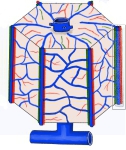 Hepatic lobule and vessels
Reference websites
[Wikipedia]
· Liver, Wikipedia.
· Portal triad, Wikipedia.
[Websites with illustrations]
· Accessory organs in digestion: the liver, pancreas and gallbladder (OpenStax Anatomy and Physiology 2e)
· Microscopic anatomy of the liver (Wikimedia Commons)

Related terms
- Portal triad
- Porta hepatis
- Interlobular connective tissue
- Interlobular bile duct
- Interlobular veins of the liver
- Liver
- Sinusoid
References and sources
- Further reading: Liver, Wikipedia.
- Further reading: Portal triad, Wikipedia.
- Federative International Programme for Anatomical Terminology (FIPAT). Terminologia Anatomica, 2nd ed. (TA2), 2019.