Renal lobe (Latin: lobus renalis)
Also called the renculus
Overview
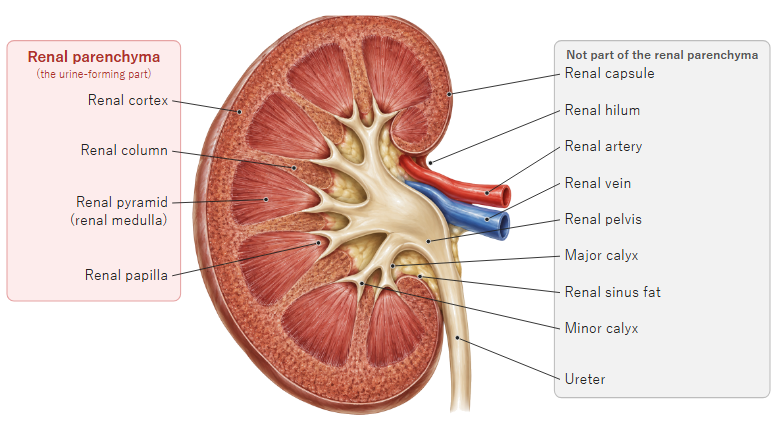
· A renal lobe is a gross unit of the kidney made of one renal pyramid together with the renal cortex that covers it, including half of each neighbouring renal column. It is also called a renculus.
· As a rule, one pyramid and the cortex around it form one renal lobe.
· The human kidney is multilobar: it is made of many lobes. The number of lobes matches the number of renal pyramids, roughly 8 to 18 (a guide figure). In small mammals such as the rat, the whole kidney is a single lobe (unilobar kidney).
· In the fetus and newborn, the borders between the lobes appear as grooves on the surface of the kidney (fetal lobulation). The grooves gradually disappear after birth but may persist in adults; on imaging they should not be mistaken for a tumour or scar.
· Renal columns lie at the borders between neighbouring lobes, and the interlobar arteries and veins ("interlobar" meaning between the lobes) run through them.
· Each renal lobe is made of many renal lobules, small units seen with the microscope. The lobes do not match the renal segments, which are defined by the territories of the segmental arteries.
Reference websites
[Wikipedia]
· Renal lobe, Wikipedia.
· Kidney, Wikipedia.
[Websites with illustrations]
· Structure of the mammalian kidney (Wikimedia Commons)

· Prenatal kidney (fetal lobulation) (Wikimedia Commons)

· Gray's Anatomy, fig. 1127 (Wikimedia Commons)

· Kidneys (Kenhub)
Related terms
- Renal pyramid
- Renal cortex
- Renal column
- Renal lobule
- Renal segments
- Renal parenchyma
- Kidney
References and sources
- Further reading: Renal lobe, Wikipedia.
- Further reading: Kidney, Wikipedia.
- Federative International Programme for Anatomical Terminology (FIPAT). Terminologia Anatomica, 2nd ed. (TA2), 2019.