Renal pyramid (Latin: pyramis renalis)
Also called the Malpighian pyramid
Overview
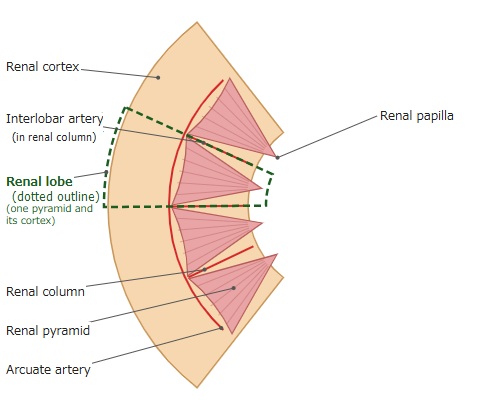
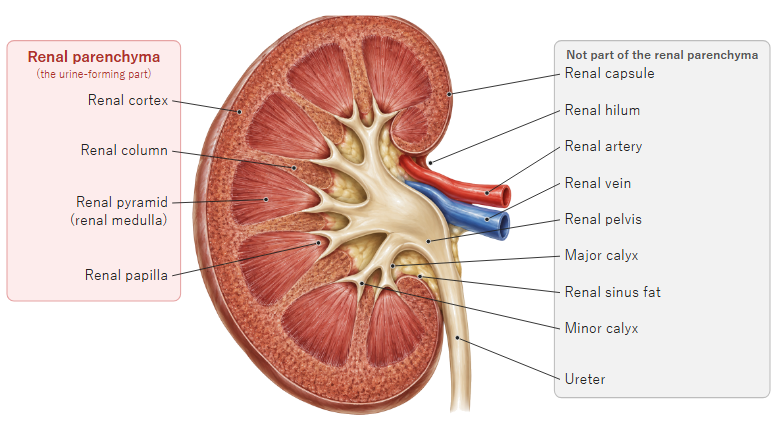
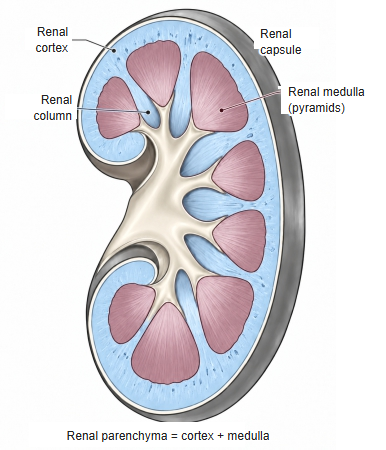
· Each kidney has about 6–20 renal pyramids, separated by the renal columns; other sources give 10–18 for the human kidney.
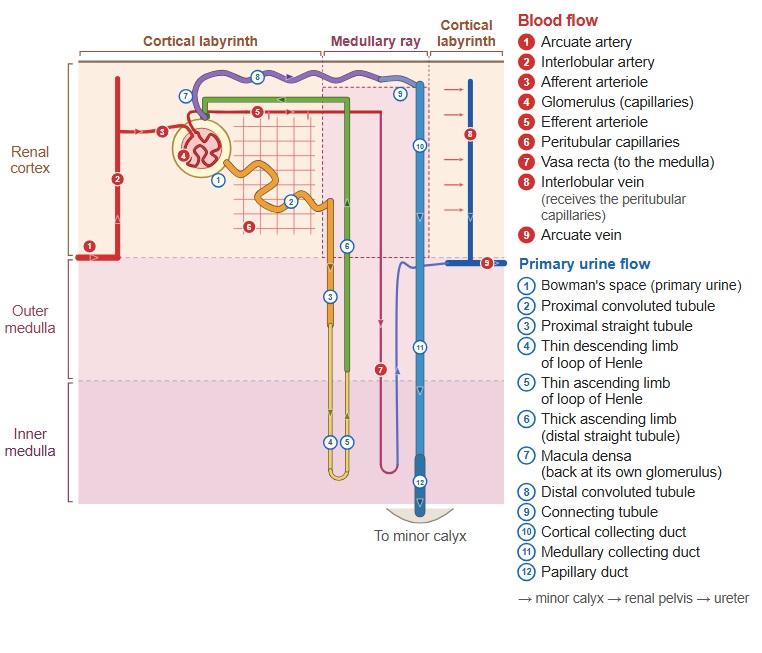
· The straight parts of the loops of Henle (proximal straight tubule, intermediate tubule and distal straight tubule) and the collecting ducts run in parallel, so a pyramid looks striped on a cut surface.
· In infants and young children, grooves marking the boundaries between the renal lobes can be seen on the surface of the kidney.
· It is also called the Malpighian pyramid, after the 17th-century Italian anatomist Marcello Malpighi.
- Renal cortex
- Renal corpuscle : glomerulus (a tuft of glomerular capillaries) and Bowman's capsule
- Proximal tubule : reabsorbs water and nutrients from the primary urine (convoluted part)
- Distal tubule : adjusts salts and water (convoluted part)
- Cortical collecting duct : collects the primary urine from several connecting tubules
- Renal medulla
- Renal pyramid : the cone-shaped tissue that forms the medulla; it contains:
- Loop of Henle : U-shaped part (proximal straight tubule, intermediate tubule, distal straight tubule)
- Medullary collecting duct : carries the primary urine toward the renal papilla
- Papillary duct : opens at the tip of the renal papilla and empties the primary urine into a minor calyx, where it becomes urine
- Renal pyramid : the cone-shaped tissue that forms the medulla; it contains:
 Renal lobe and renal lobule
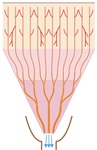 The whole collecting duct
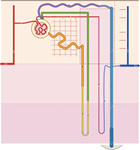 Nephron and blood vessels
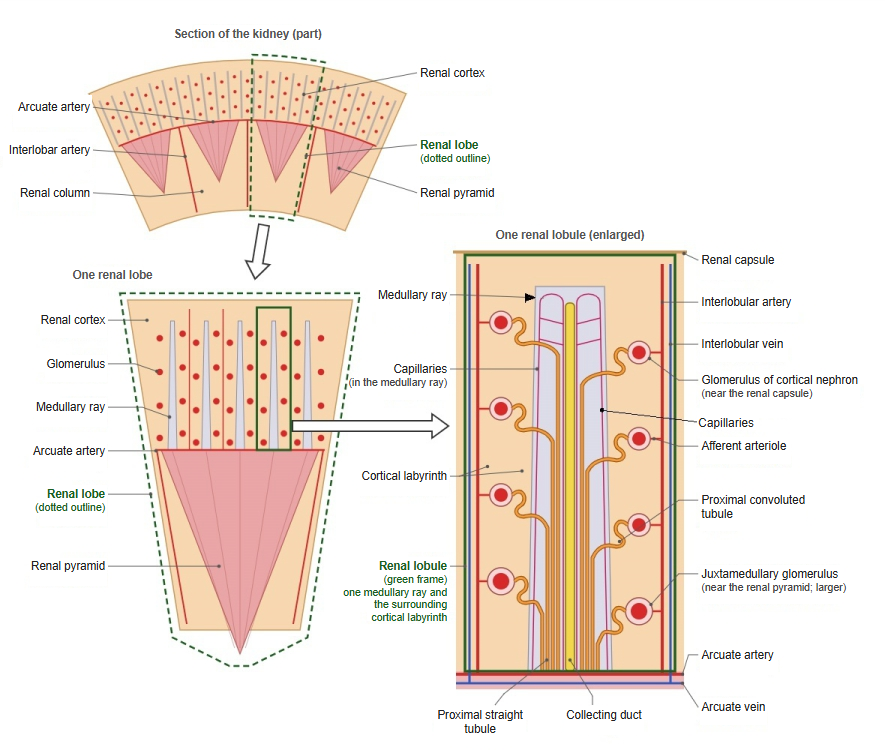
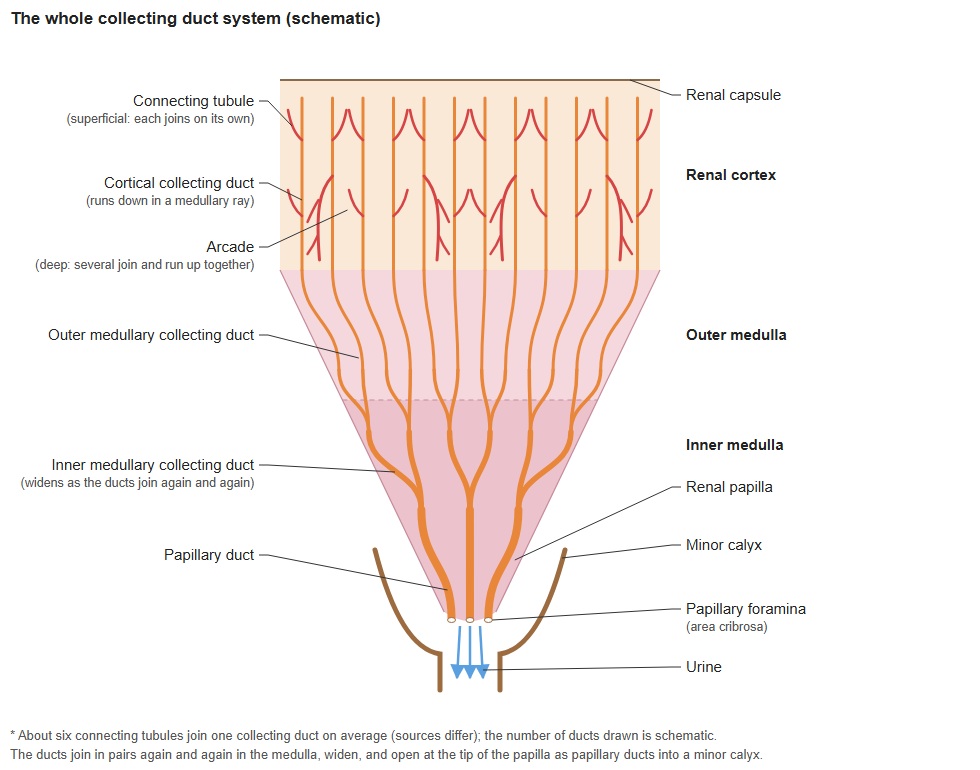
Reference websites
[Wikipedia]
· Renal pyramids, Wikipedia.
· Kidney, Wikipedia.
[Websites with illustrations]
· The kidneys (Visible Body)
· Gross anatomy of the kidney (Lumen Learning, Anatomy and Physiology II)
· Kidney anatomy (Blausen) (Wikimedia Commons)

· Hydronephrosis (ultrasound) (NYSORA)
Related terms
References and sources
- Further reading: Renal pyramids, Wikipedia.
- Further reading: Kidney, Wikipedia.
- Federative International Programme for Anatomical Terminology (FIPAT). Terminologia Anatomica, 2nd ed. (TA2), 2019.