Intrajugular process of temporal bone (Latin: processus intrajugularis ossis temporalis)
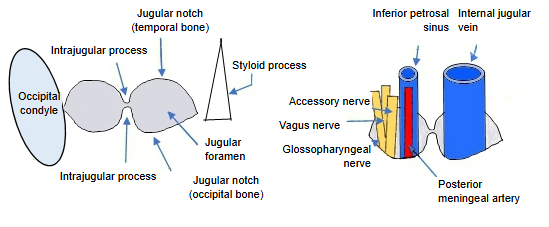
Jugular foramen: the opening between the occipital condyle and the styloid process through which nerves and vessels leave the skull.
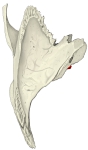 Left temporal bone (superior view)
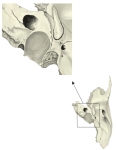 Left temporal bone (around the jugular fossa)
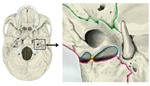 External cranial base: left jugular foramen
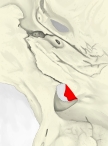 Jugular foramen seen from the internal cranial base
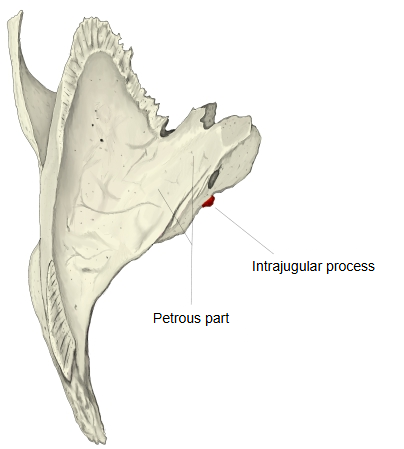
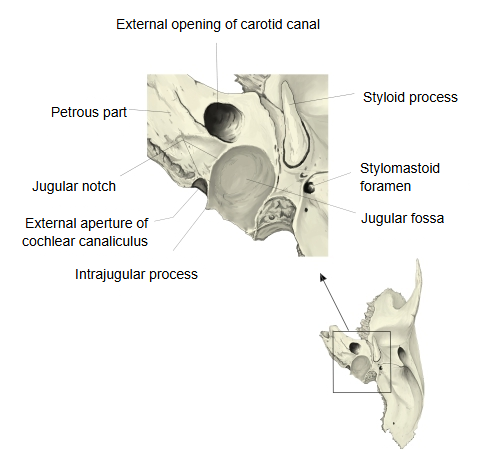
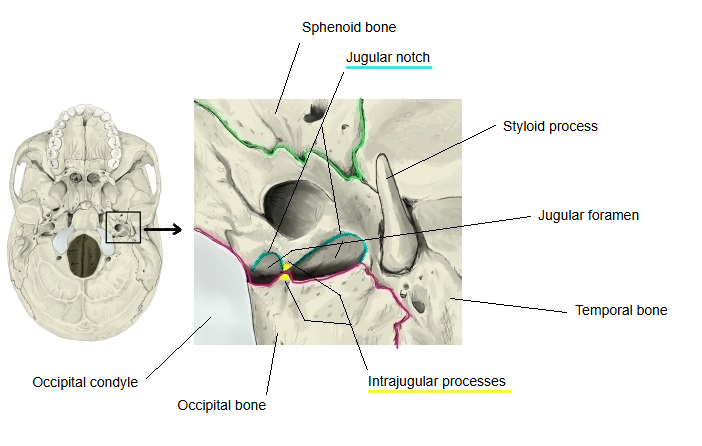
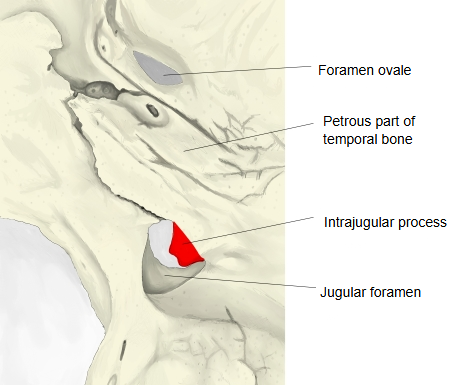
The jugular foramen is divided into a smaller anteromedial (front) part and a larger posterolateral (back) part by the intrajugular processes arising from the occipital bone and the temporal bone. The front part carries the inferior petrosal sinus and the glossopharyngeal nerve; the back part carries the sigmoid sinus as it becomes the internal jugular vein. Sources differ on whether the vagus and accessory nerves pass in the front part or with the vein in the back part. The two processes are joined by fibrous tissue or a bony bridge, and their size varies: a distinct spine, a low ridge, or absent.
Reference websites
[Wikipedia]
· Jugular foramen, Wikipedia.
[Websites with illustrations]
· Jugular foramen: anatomy, location and function (Kenhub)
· Base of the skull, outer surface (Gray's Anatomy, plate 187) (Wikimedia Commons)

· Left temporal bone, inferior surface (Gray's Anatomy, plate 141) (Wikimedia Commons)

Related terms
- Jugular foramen
- Jugular notch
- Petrous part
- External cranial base
- Posterior cranial fossa
- Intrajugular process of occipital bone
References and sources
- Further reading: Jugular foramen, Wikipedia.
- Federative International Programme for Anatomical Terminology (FIPAT). Terminologia Anatomica, 2nd ed. (TA2), 2019.