External cranial base (Latin: basis cranii externa)
Also called the inferior surface of the skull
- Internal cranial base : anterior, middle and posterior cranial fossae
- External cranial base : anterior, middle and posterior parts
Note: what exactly the "external cranial base" includes is often not clear, because textbooks define its extent in slightly different ways (see below).
It is usually described as the under surface of the skull without the mandible and the hyoid bone. It reaches from the alveolar arch of the maxilla (the upper dental arch) in front to the superior nuchal lines and the external occipital protuberance behind; at the sides it is bounded by the infratemporal crest, the back end of the zygomatic arch and the medial side of the mastoid process.
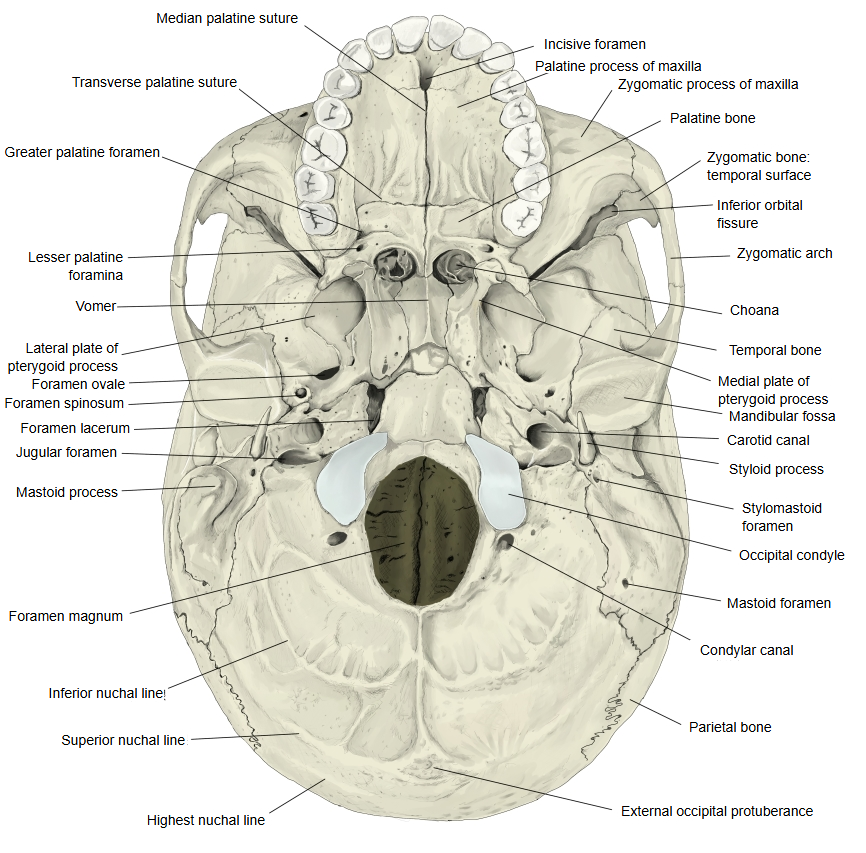
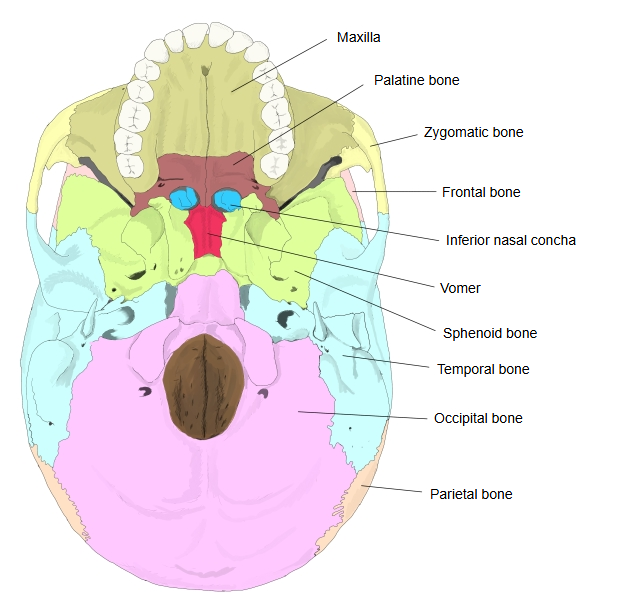
It is an uneven, bulging surface with many processes and fossae, and with many openings for the vessels and nerves entering and leaving the cranial cavity. It is formed by the maxilla, palatine bone, vomer, sphenoid bone, temporal bone and occipital bone, with small parts of the zygomatic bone at the sides. The figures below show it (skull, inferior view).
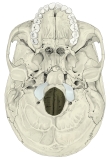 External cranial base
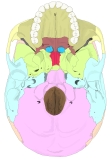 External cranial base (bones colour-coded)
The cranial base is the floor of the neurocranium and the part through which the vessels and nerves enter and leave the cranial cavity. Its outer surface is the external cranial base and its inner surface the internal cranial base. Its bones ossify from the cartilaginous skull (chondrocranium) and are made mainly of spongy bone.
Three parts
The external cranial base is divided into anterior, middle and posterior parts.
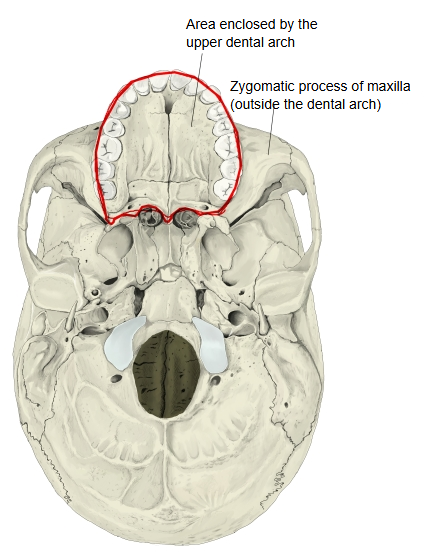
Anterior part: the bony palate (hard palate) enclosed by the upper dental arch, with the incisive foramen and the greater and lesser palatine foramina.
Middle part: from the back of the hard palate to the front of the foramen magnum. It includes the choanae between the pterygoid processes, the foramen ovale, foramen spinosum, foramen lacerum, carotid canal and jugular foramen; lateral to the pterygoid processes lie the infratemporal fossa and the pterygopalatine fossa.
Posterior part: from the foramen magnum to the superior nuchal lines. It bears the occipital condyles, the hypoglossal and condylar canals, the mastoid process and the nuchal lines.
Sources differ on the front limit. If the cranial base is taken strictly as the floor of the neurocranium, the maxilla, a bone of the facial skeleton, would not belong to it. Yet the usual description of the anterior part, the bony palate enclosed by the upper dental arch, does include the palatine processes of the maxillae. Whether parts of the maxilla outside the dental arch, such as its zygomatic process, belong to the external cranial base is then left open.
Related terms
- Foramen magnum
- Hard palate
- Choana
- Jugular foramen
- Skull (inferior view)
- Occipital condyle
- Infratemporal fossa
References and sources
- Further reading: Base of skull, Wikipedia.
- Federative International Programme for Anatomical Terminology (FIPAT). Terminologia Anatomica, 2nd ed. (TA2), 2019.