Foramen cecum of tongue (Latin: foramen caecum linguae)
Also called the foramen caecum of tongue
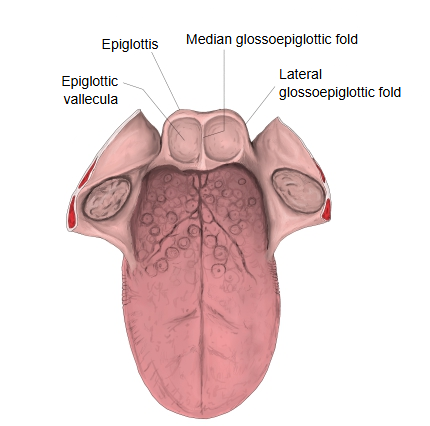
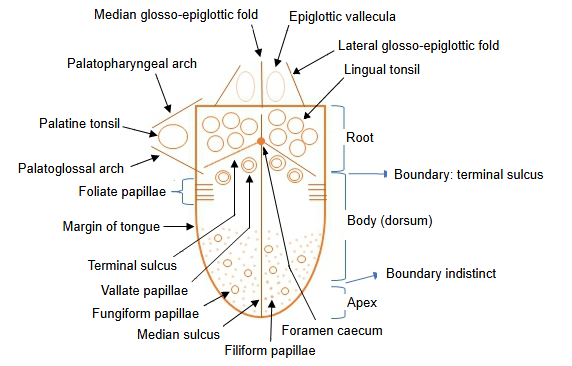
The foramen cecum is the small pit in the midline at the back end of the dorsum of the tongue, where the median sulcus ends and the terminal sulcus begins.
Dorsum of the tongue: its back end is the boundary between the dorsum and the root of the tongueSmall pit: rarely it leads into a deep blind canal, the lingual duct
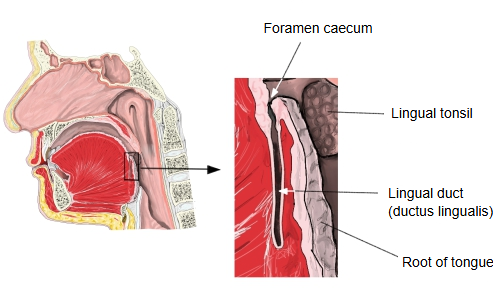
· The foramen cecum is the remnant of the thyroglossal duct, which in the embryo joined the tongue to the upper border of the isthmus of the developing thyroid gland. Rarely it leads into a deep blind canal, the lingual duct.
· The short canal that continues from the pit is called the lingual duct (ductus lingualis); the ducts of a few lingual glands open into it.
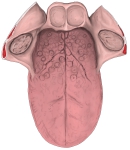 Around the tongue
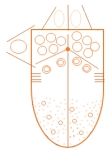 Tongue (diagram)
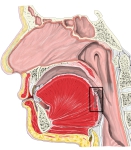 Foramen cecum and lingual duct
Reference websites
[Wikipedia]
· Foramen cecum (tongue), Wikipedia.
· Thyroglossal duct, Wikipedia.
[Websites with illustrations]
· Structure of the tongue (illustration) (Kenhub)

· Dorsum of the tongue (figure) (Springer Nature)

Related terms
- Lingual duct
- Terminal sulcus of tongue
- Median sulcus of tongue
- Dorsum of tongue
- Root of tongue
- Lingual glands
- Lingual tonsil
References and sources
- Further reading: Foramen cecum (tongue), Wikipedia.
- Further reading: Thyroglossal duct, Wikipedia.
- Federative International Programme for Anatomical Terminology (FIPAT). Terminologia Anatomica, 2nd ed. (TA2), 2019.