Sacrococcygeus dorsalis (Latin: musculus sacrococcygeus dorsalis)
- Overview
- Illustrations
- Origin / insertion
- Action
- Nerve / blood supply
- Reference websites
- (Wikipedia, websites with illustrations)
- Related terms
Overview
- Back (21)
- Thorax (11)
- Abdomen (6)
- Pelvis (4)
- Levator ani (1) : parts: pubococcygeus, puborectalis, iliococcygeus
- Coccygeal muscles (3) : sacrococcygeus ventralis, sacrococcygeus dorsalis, coccygeus
- Perineum (10)
· Often absent. It is a slender band on the dorsal surface of the sacrum and coccyx, and corresponds to the muscles that extend (raise) the tail in other mammals.
Illustrations
More figures: Multi-muscle illustrations: Abdomen and perineum · Muscles of the trunk (list)
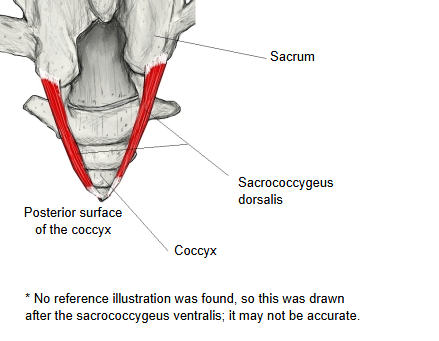
Note : no illustration of this muscle could be found in anatomy books or on the internet, so the drawing below was made after the sacrococcygeus ventralis. Its position and size should be roughly right, but it may not be accurate.
Origin / insertion
[Origin] : the dorsal surface of the sacrum (lower part; probably the lowest sacral vertebra, like the sacrococcygeus ventralis).
[Insertion] : the dorsal surface of the coccyx (probably its lower vertebrae). The exact attachments are not well described.
Action
A rudimentary muscle with no significant action; at most it could extend the coccyx slightly.
Nerve / blood supply
· Nerve : a branch of the sacral nerves (S5).
· Arteries : not described in standard texts.
· Veins : not described in standard texts.
Reference websites
[Wikipedia]
· Coccyx: Extensor coccygis, Wikipedia.
[Websites with illustrations]
· Coccyx (Kenhub)
Related terms
- Dorsal surface of sacrum
- Coccygeal vertebrae
- Sacrococcygeal joint
- Sacrococcygeus ventralis
- Coccygeus
- Sacrum
- Coccyx
- Sacral nerves
References and sources
- FIPAT. Terminologia Anatomica, 2nd ed. (TA2), 2019: musculus sacrococcygeus dorsalis.
- Coccyx: Extensor coccygis, Wikipedia.