Puboprostaticus (Latin: musculus puboprostaticus)
- Overview
- Illustrations
- Origin / insertion
- Action
- Nerve / blood supply
- Reference websites
- (Wikipedia, websites with illustrations)
- Related terms
Overview
- Back (21)
- Thorax (11)
- Abdomen (6)
- Pelvis (4)
- Levator ani (1) : parts: pubococcygeus (its parts: puboperinealis, puboprostaticus (male) / pubovaginalis (female), puboanalis), puborectalis, iliococcygeus
- Coccygeal muscles (3)
- Perineum (10)
· TA2 divides the pubococcygeus into the puboperinealis, puboprostaticus / pubovaginalis and puboanalis (the puboprostaticus in the male and the pubovaginalis in the female), named by where the fibres end. They are not separate muscles that can be cleanly dissected out; how distinct they are varies from person to person.
· Its fibres form a sling on each side of the prostate, at the front of the urogenital hiatus; its female counterpart is the pubovaginalis.
⇒ Classification of the muscles of the perineum
Illustrations
More figures: Multi-muscle illustrations: Abdomen and perineum · Muscles of the trunk (list)
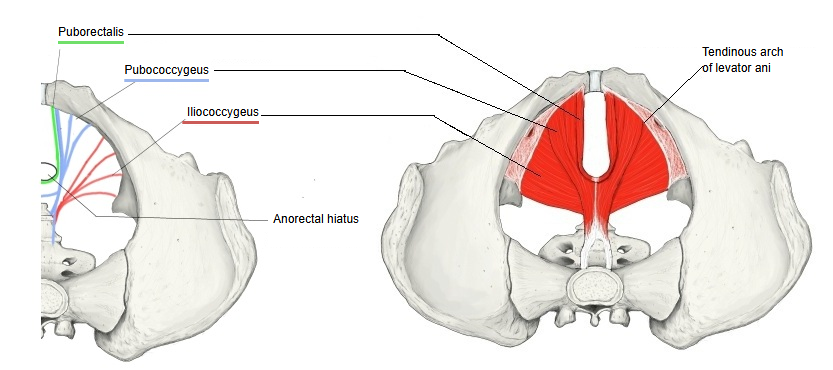
Origin / insertion
[Origin] : the back (pelvic) surface of the body of the pubis, beside the pubic symphysis.
[Insertion] : the fascia on the side of the prostate, and the perineal body behind it.
Sources differ on how far the fibres reach: some describe them as ending in the prostatic fascia, others as passing on to the perineal body.
Action
Supports and raises the prostate and compresses it from the sides. It is thought to help with continence of urine by supporting the neck of the bladder and the urethra.
Nerve / blood supply
· Nerve : the nerve to the levator ani (S3–S4) from above, and branches of the pudendal nerve (inferior rectal nerves and perineal nerve) from below. Sources differ on how much the pudendal nerve contributes.
· Arteries : the inferior vesical artery (with its prostatic branches) and the middle rectal artery, branches of the internal iliac artery.
· Veins : follow the arteries to the internal iliac vein (internal pudendal vein).
Reference websites
[Wikipedia]
· Pubococcygeus muscle, Wikipedia.
[Websites with illustrations]
· Levator ani (Kenhub)
Related terms
- Prostate
- Puboprostatic ligament
- External urethral sphincter
- Perineal body
- Pelvic diaphragm
- Pelvic floor
- Urogenital hiatus
- Levator ani
- Pubococcygeus
- Puborectalis
References and sources
- FIPAT. Terminologia Anatomica, 2nd ed. (TA2), 2019: musculus puboprostaticus (part of musculus pubococcygeus, musculus levator ani).
- Kearney R, Sawhney R, DeLancey JOL. Levator ani muscle anatomy evaluated by origin–insertion pairs. Obstet Gynecol 2004; 104(1): 168–173.
- Pubococcygeus muscle, Wikipedia.