Neurotransmitter
Overview
· In other words, it is a molecule that turns the electrical signal of a nerve into a chemical signal and passes the information accurately to the next cell.
- Physiologically active substances : made in the body: hormones, neurotransmitters, etc.
- Substances from outside the body : drugs; substances in food (caffeine, capsaicin, etc.); substances from microorganisms (penicillin, etc.)
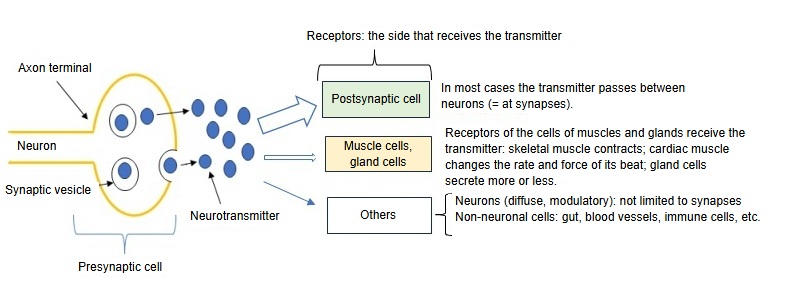
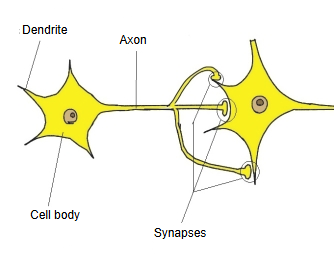
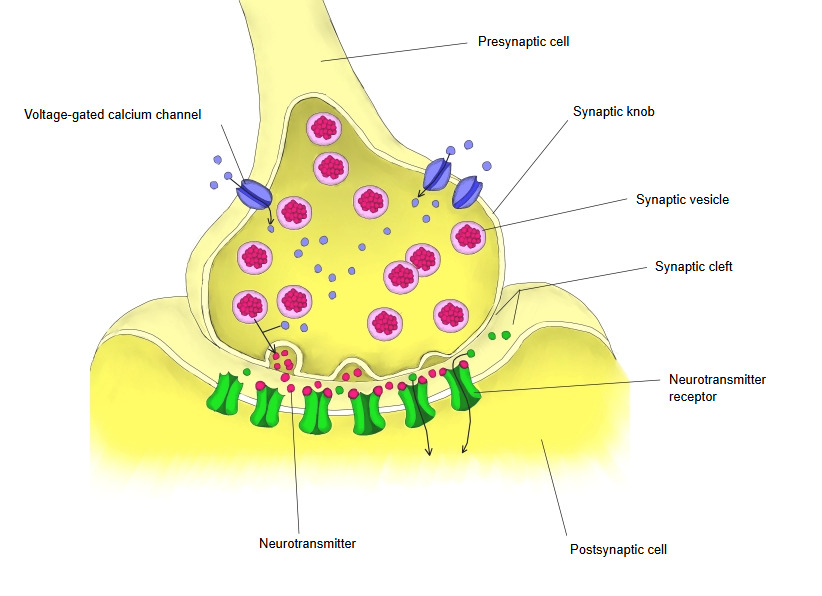
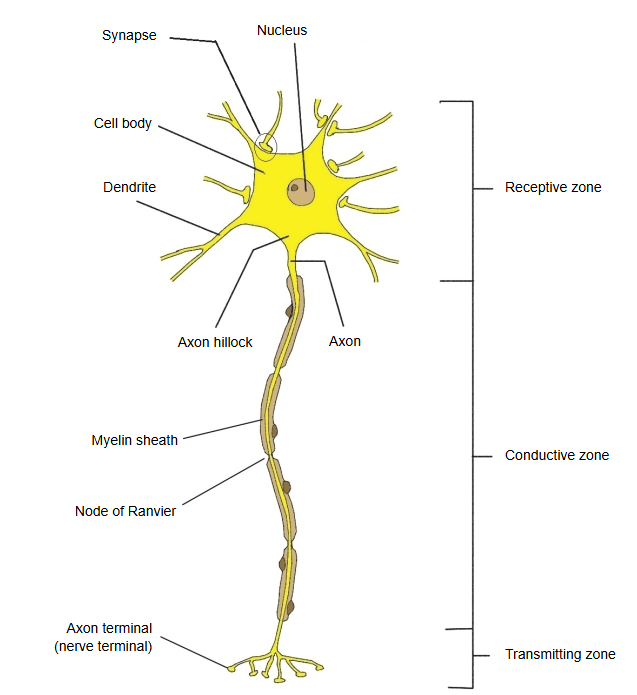
In the central nervous system (the mass of neurons that continues from the brain to the spinal cord), neurons are separated by a very narrow gap, only a few tens of nanometres wide, at the junctions called synapses (chemical synapses). The substances that carry the nerve signals across this gap are the neurotransmitters.
The presynaptic cell, at its axon terminal, has the system that makes the neurotransmitter, and the postsynaptic cell has the receptors for it. After release the transmitter is quickly inactivated. In a wider sense, zinc ions and nitric oxide, which also act on the postsynaptic cell, are neurotransmitters too. Hormones are also messengers between cells, released by exocytosis and bound by receptors; but neurotransmitters act locally, whereas hormones act widely through the circulation. Agonists and antagonists, substances that act on the same receptors, mimic or block the action of a neurotransmitter.
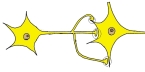 Synapses between two neurons
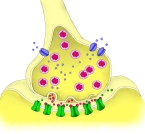 Structure of a chemical synapse
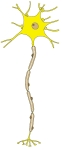 Neuron
Main neurotransmitters
Much of brain science is still unexplained. The table below lists representative neurotransmitters, among them those with a large influence on mental activity. Dopamine, noradrenaline, adrenaline, serotonin and histamine are the monoamine neurotransmitters, which influence many parts of the brain.
- Amino acids : glutamate, gamma-aminobutyric acid (GABA), glycine
- Monoamines : dopamine, noradrenaline, adrenaline, serotonin, histamine
- Cholinergic : acetylcholine
- Main peptides : substance P, enkephalins and endorphins, vasoactive intestinal peptide
- Gases and lipids : nitric oxide (a gas); endocannabinoids (lipids)
| Neurotransmitter | Released by (main nerves or cells) | Acts on | Typical actions | |
|---|---|---|---|---|
| 1 | Glutamate | Excitatory neurons of the central nervous system | Neurons of the central nervous system | Excitatory transmission; learning and memory (long-term potentiation) |
| 2 | Gamma-aminobutyric acid (GABA) | Inhibitory interneurons | Neurons of the central nervous system | Inhibition; reduction of anxiety; sedation |
| 3 | Glycine | Neurons of the spinal cord and brainstem | Motor neurons and others | Inhibition; control of reflexes |
| 4 | Acetylcholine | Motor nerves, autonomic nerves (parasympathetic), central nervous system | Skeletal muscle, heart, gland cells | Muscle contraction, slower heart rate, more secretion |
| 5 | Dopamine | Midbrain (substantia nigra, ventral tegmental area) | Neurons of the central nervous system | Control of movement, reward, motivation |
| 6 | Noradrenaline | Locus coeruleus; sympathetic postganglionic fibres | Central nervous system and peripheral organs | Wakefulness, attention, raised blood pressure |
| 7 | Adrenaline | Medulla of the suprarenal gland (* neuroendocrine) | Heart, blood vessels, etc. | Fight-or-flight response, faster heart rate |
| 8 | Serotonin (5-HT) | Raphe nuclei, enterochromaffin cells | Central nervous system, enteric nervous system | Stable mood, regulation of sleep, movement of the gut |
| 9 | Histamine | Neurons of the hypothalamus | Central nervous system | Wakefulness, reduced appetite |
| 10 | Substance P | Sensory nerves | Central nervous system | Transmission of pain |
| 11 | Endorphins | Central nervous system | Central nervous system | Pain relief, euphoria |
| 12 | Nitric oxide | Neurons, endothelial cells | Surrounding cells (by diffusion) | Widening of blood vessels, modulation of nerve activity |
Related terms
References and sources
- Further reading: Neurotransmitter, Wikipedia.
- Federative International Programme for Anatomical Terminology (FIPAT). Terminologia Anatomica, 2nd ed. (TA2), 2019.