Fatty acids
- Overview
- Digestion and absorption
- Functions
- Classification
- Reference websites
- (Wikipedia)
- Related terms
Overview
· A fatty acid is a carboxylic acid: a hydrocarbon chain with a carboxyl group (–COOH) at one end.
major
nutrients
- Protein : large molecules made of many amino acids joined in chains; abundant in meat and fish; the material of muscle, bone and other tissues.
- Carbohydrate : sugars (including starch) and dietary fibre; an important source of energy in the body.
- Lipids (= fat) : provide more than twice as much energy per gram as the other nutrients; abundant in oils and meat; used mainly as a source of energy.
in the
body
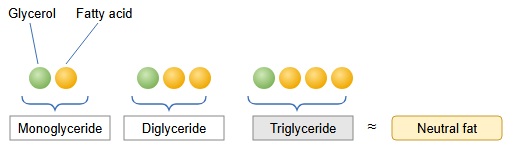
- Neutral fat : ≈ triglyceride; stored in fat cells as a reserve of energy.
- Fatty acids : stored mainly as part of neutral fat in adipose tissue; used as a source of energy, especially by muscle.
- Cholesterol : an essential component of the cell membrane; also the raw material of some hormones and of bile acids.
- Phospholipids : the main building units of the cell membrane; also take part in signalling.
· Fatty acids bound to glycerol (as esters) form the acylglycerols, which make up fats and oils.
Digestion and absorption
In the body most fat is stored as triglyceride in adipose tissue and used as a source of energy; it is also a component of other cells and of hormones.
Functions
Fatty acids are used as a fuel in many tissues by aerobic breakdown (beta-oxidation). The inner membrane of the mitochondrion does not let the activated fatty acid (fatty acyl-CoA) through, so carnitine acts as its carrier: the fatty acid is bound to carnitine, carried into the mitochondrion and then broken down by beta-oxidation to acetyl-CoA, which enters the citric acid cycle to release energy.
In muscle
Classification
By the number of carbon atoms
| Carbon atoms | Name | Abbreviation | |
|---|---|---|---|
| 1 | fewer than 6 | Short-chain fatty acids | SCFA |
| 2 | 6–12 | Medium-chain fatty acids | MCFA |
| 3 | 13–21 | Long-chain fatty acids | LCFA |
| 4 | 22 or more | Very-long-chain fatty acids | VLCFA |
※ Fatty acids with 10 or more carbon atoms are also called higher fatty acids.
By the degree of saturation
By the presence of double bonds, fatty acids are divided into saturated fatty acids and unsaturated fatty acids.
acids
- Saturated fatty acids : no carbon–carbon double or triple bonds; abundant in animal fats; e.g. butyric, palmitic and stearic acid.
- Unsaturated fatty acids : one or more carbon–carbon double bonds.
- Monounsaturated : one double bond; typical example oleic acid (olive oil).
- Polyunsaturated : two or more double bonds.
- n-3 fatty acids : alpha-linolenic acid●, eicosapentaenoic acid (EPA), docosahexaenoic acid (DHA) and others.
- n-6 fatty acids : linoleic acid●, gamma-linolenic acid, arachidonic acid and others.
● Essential fatty acids. Unsaturated fatty acids occur in a cis and a trans form; almost all natural ones are cis.
Reference websites
[Wikipedia]
· Fatty acid, Wikipedia.
Related terms
- Fat
- Neutral fat
- Saturated fatty acids
- Unsaturated fatty acids
- Essential fatty acids
- Free fatty acids
- Carnitine
References and sources
- Further reading: Fatty acid, Wikipedia.
- Federative International Programme for Anatomical Terminology (FIPAT). Terminologia Anatomica, 2nd ed. (TA2), 2019.