Phospholipids
- Overview
- Structure
- Classification
- Biosynthesis
- Roles
- Main phospholipids
- Reference websites
- (Wikipedia)
- Related terms
Overview
in the
body
- Neutral fat : ≈ triglyceride; stored in fat cells as a reserve of energy.
- Fatty acids : stored mainly as part of neutral fat in adipose tissue; used as a source of energy, especially by muscle.
- Cholesterol : an essential component of the cell membrane; also the raw material of some hormones and of bile acids.
- Phospholipids : the main building units of the cell membrane; also take part in signalling.
· Their molecules are amphipathic: a hydrophilic (water-attracting) head containing the phosphate group and hydrophobic tails of fatty acids.
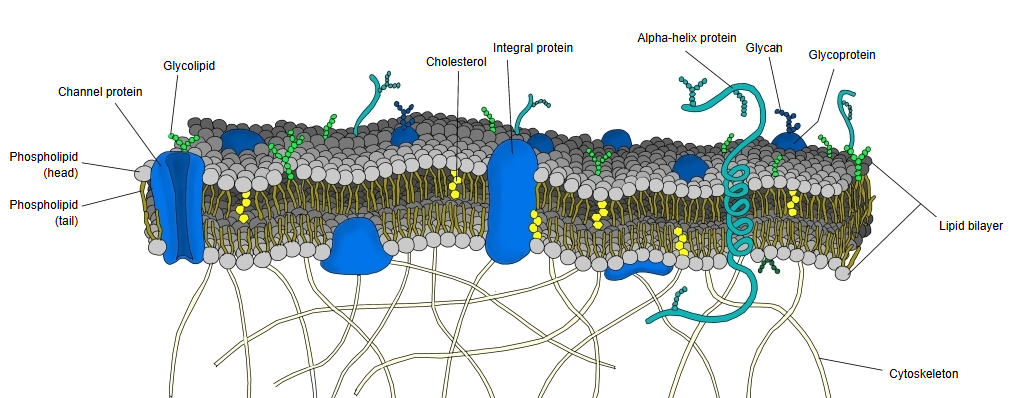
· In water they form a lipid bilayer, the basic structure of the cell membrane and of the membranes of the organelles.
· Besides being the main building units of membranes, they take part in signalling in the body.
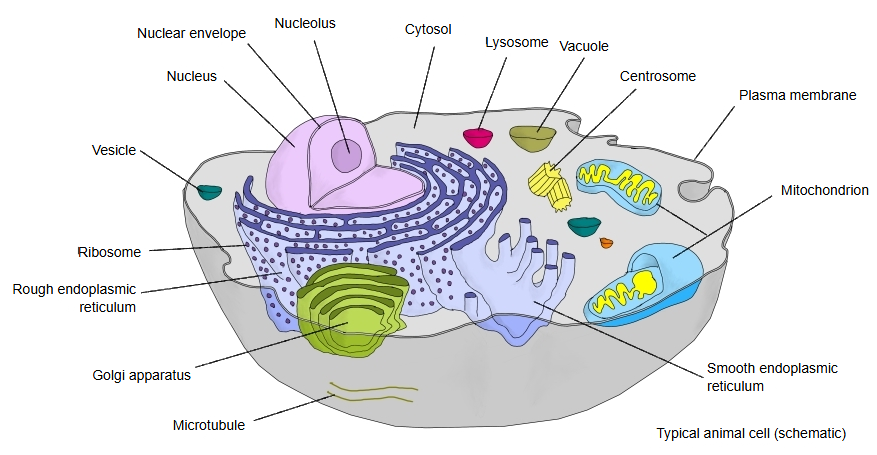
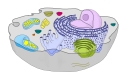 Typical animal cell
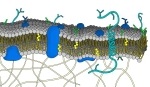 Structure of the cell membrane
Structure
A typical phospholipid (a glycerophospholipid) is built on glycerol: two of its hydroxyl groups are bound to fatty acids by ester bonds and the third to phosphoric acid. The phosphate is usually bound to a further small molecule, such as choline, ethanolamine, serine or inositol; several of these contain nitrogen. Because the fatty acids and the head groups vary, there are very many kinds of phospholipids.
The fatty-acid tails are hydrophobic, while the phosphate group carries a negative charge and is hydrophilic, so phospholipids behave like detergents (surfactants). In water they gather with the tails inside and the heads outside, forming vesicles and stable lipid bilayers.
Classification
lipids
- Glycerophospholipids : backbone: glycerol.
- Sphingophospholipids : backbone: sphingosine.
Glycerophospholipids are built on glycerol. The simplest is phosphatidic acid (glycerol with two fatty acids and a phosphate); the others carry a further molecule on the phosphate, as in phosphatidylcholine. In many of them a saturated fatty acid is bound to carbon 1 and an unsaturated fatty acid to carbon 2. In plasmalogens the chain on carbon 1 is bound by an ether bond instead of an ester bond.
Sphingophospholipids are built on sphingosine, which is made from palmitic acid and the amino acid serine; a fatty acid is bound to its amino group by an amide bond. The main example is sphingomyelin.
Biosynthesis
Glycerophospholipids are made mainly in the endoplasmic reticulum. In the main pathway the head-group molecule (for example choline or ethanolamine) is first phosphorylated by a kinase using ATP, then activated with CTP, and finally transferred to diacylglycerol. Phosphatidylcholine can also be made by methylation of phosphatidylethanolamine, and phosphatidylserine by exchanging the head group of another phospholipid for serine.
Sphingomyelin is made from ceramide (sphingosine carrying a fatty acid), which receives a phosphocholine group from phosphatidylcholine.
Roles
[1. Main components of cell membranes]
· Phospholipids assemble by themselves into lipid bilayers, the basic structure of the cell membrane and of the membranes of organelles such as the mitochondria.
[2. Transport into and out of cells]
· Small vesicles bounded by a phospholipid bilayer carry substances into and out of cells and between the organelles.
[3. Signalling]
· Enzymes such as phospholipase A2 and phospholipase C split phospholipids into signalling molecules: inositol trisphosphate and diacylglycerol act as second messengers, and arachidonic acid released from phospholipids is the starting material of prostaglandins and other eicosanoids.
Main phospholipids
The main phospholipids are:
| Name | Notes | |
|---|---|---|
| 1 | Phosphatidylcholine | Also called lecithin; the most abundant phospholipid of animal cell membranes. A source of choline for making acetylcholine. |
| 2 | Phosphatidylethanolamine | Also called cephalin (kephalin). |
| 3 | Phosphatidylinositol | A minor component of the cell membrane, but its phosphorylated forms take part in signalling (for example as the source of second messengers). There are several forms that differ in the number of phosphate groups. |
| 4 | Phosphatidylserine | Has serine as its head group; in the cell membrane it lies mainly in the inner layer. |
| 5 | Phosphatidylglycerol | Abundant in the leaves of plants (chloroplast membranes). |
| 6 | Diphosphatidylglycerol | Also called cardiolipin. Found in the inner membrane of the mitochondria, which contains the electron transport chain. |
| 7 | Sphingomyelin | Abundant in the myelin sheath of nerve fibres. |
Reference websites
[Wikipedia]
· Phospholipid, Wikipedia.
Related terms
References and sources
- Further reading: Phospholipid, Wikipedia.
- Federative International Programme for Anatomical Terminology (FIPAT). Terminologia Anatomica, 2nd ed. (TA2), 2019.