Proteoglycan
Overview
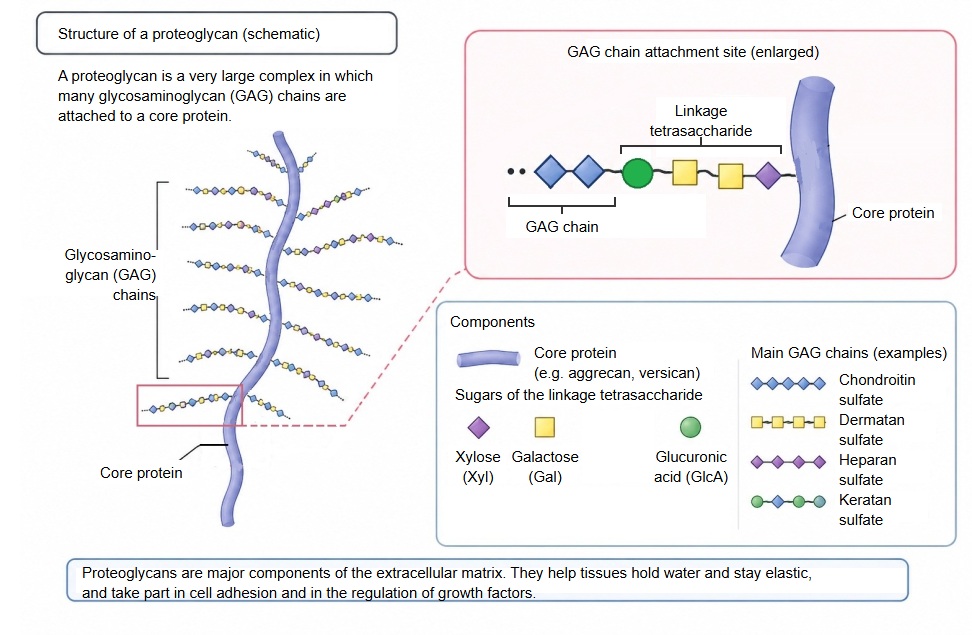
A proteoglycan is a conjugated protein: a core protein to which long sugar chains (glycosaminoglycans) are attached. It is related to the glycoproteins but is usually distinguished from them, because its sugar chains are much longer.
The sugar chains make up most of the mass of the molecule.
A typical proteoglycan is a core protein + glycosaminoglycan chains (long, unbranched polysaccharides).
Core proteins differ greatly in size.From a single chain to a great many chains per core protein.
| Core protein | Main location | GAG chains | Shape and role | |
|---|---|---|---|---|
| 1 | Aggrecan | Cartilage, intervertebral discs | Very many (chondroitin sulfate and keratan sulfate) | A very large molecule shaped like a bottle brush. Many aggrecan molecules bind to one chain of hyaluronic acid; the aggregates hold a great deal of water and let cartilage resist compression. |
| 2 | Decorin | Skin, tendons and other connective tissues | One | A small proteoglycan. It binds to collagen fibrils (it 'decorates' them, hence the name) and helps to organize them. |
| 3 | Syndecans | Cell surface | A few (mainly heparan sulfate) | Pass through the cell membrane. They act as co-receptors that help cells respond to growth factors and attach to the matrix. |
Types
Proteoglycans are usually grouped by where they are found.
| Class | Main roles and examples | |
|---|---|---|
| 1 | Extracellular (interstitial) | Fill the spaces of the extracellular matrix between the collagen fibres and the hyaluronic acid, holding water and resisting compression (e.g. aggrecan, versican, decorin). |
| 2 | Cell surface | Anchored in or on the cell membrane; they bind growth factors and other signals and pass them to the cell (e.g. syndecans, glypicans). |
| 3 | Basement membrane | Part of the basement membrane under epithelia; they help it to act as a filter and to hold cells in place (e.g. perlecan, agrin). |
| 4 | Intracellular | Serglycin, in the secretory granules of mast cells and other blood-forming cells, where it helps to store proteases and other granule contents. |
Reference websites
[Wikipedia]
· Proteoglycan, Wikipedia.
Related terms
- Extracellular matrix
- Cartilage
- Hyaline cartilage
- Connective tissue
- Basement membrane
- Collagen fiber
- Mast cell
References and sources
- Further reading: Proteoglycan, Wikipedia.
- Federative International Programme for Anatomical Terminology (FIPAT). Terminologia Anatomica, 2nd ed. (TA2), 2019.