Glycoproteins
Glycoprotein
Overview
| Classification of proteins by composition | ||
|---|---|---|
| Simple proteins | Made of amino acids only. Examples: albumins, globulins, protamines, histones, glutelins, prolamins, scleroproteins | |
| Conjugated proteins | Protein + a non-protein part | |
| Glycoproteins | + sugar (oligosaccharides). Examples: antibodies, some hormones, mucin | |
| Lipoproteins | + lipid. Examples: high- and low-density lipoproteins (HDL, LDL) | |
| Chromoproteins | + pigment (such as heme). Examples: hemoglobin, cytochromes | |
| Nucleoproteins | + nucleic acid (DNA or RNA). Examples: ribosomes, chromatin (histones with DNA) | |
| Phosphoproteins | + phosphate groups. Example: casein (milk) | |
| Metalloproteins | + metal ions (Fe, Zn, Cu and others). Examples: ferritin, catalase | |
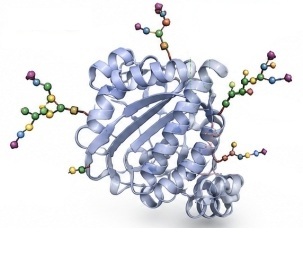
Kinds
Collagen consists of three chains of amino acids wound together into a long, strong, rope-like triple helix. A small amount of sugar (galactose, or galactose with glucose) is attached at many points to a special amino acid, hydroxylysine. Although the sugars make up only a few percent of its weight, by definition every protein with attached sugar chains is a glycoprotein, so collagen is included.
Location
· Cell membrane: the surface of cells is densely covered with sugar chains projecting from glycoproteins (and glycolipids); this coat is called the glycocalyx.
· Between cells: they help to maintain the shape of tissues and to hold cells together.
· Secretions: immunoglobulins (antibodies), mucin (in most digestive juices, mucus and tears) and various digestive enzymes (such as amylase).
| Glycoproteins on the cell surface | How they are attached to the cell membrane |
|---|---|
| Single-pass transmembrane glycoproteins | The protein crosses the membrane once |
| Multi-pass transmembrane glycoproteins | The protein crosses the membrane several times |
| GPI-anchored glycoproteins | The protein is attached to the outer layer of the membrane by a glycolipid anchor (GPI anchor) |
| Peripheral glycoproteins | The protein is bound to the membrane surface |
| The sugar chains always face the outside of the cell. They take part in cell recognition (as markers of the cell), cell adhesion, signalling (as receptors), regulation of enzymes, immune responses and the binding of hormones and pathogens. | |
Typical glycoproteins
| Glycoprotein | Main location | Main role | |
|---|---|---|---|
| 1 | Immunoglobulins | Blood, lymph, saliva and others | Bind to and neutralize pathogens (viruses, bacteria) that enter the body |
| 2 | Mucin | Mucous membranes of the stomach, intestine, trachea, mouth and others | Holds large amounts of water to form viscous mucus, which protects the walls of the tissues from acid and friction |
| 3 | Transferrin | Blood (serum) | Binds iron (Fe) and carries it safely to the cells of the body |
| 4 | Erythropoietin | Secreted by the kidney into the blood | A hormone that stimulates the bone marrow to produce more red blood cells |
| 5 | Gonadotropins | Secreted by the pituitary gland and the placenta into the blood | Stimulate the gonads (ovaries and testes) and control the secretion of sex hormones and the maintenance of pregnancy |
| 6 | Thyroid-stimulating hormone | Secreted by the pituitary gland into the blood | Stimulates the thyroid gland to secrete thyroid hormones, which raise the body's metabolism |
| 7 | Receptors of the cell membrane | Surface of the cell membrane of all cells | Receive outside signals such as hormones and neurotransmitters |
| 8 | Cell adhesion molecules | Surface of the cell membrane of all cells | Bind cells firmly to each other |
| 9 | Laminin | Basement membrane under epithelial tissue | Attaches the underside of the cells to the basement membrane |
| 10 | Fibronectin | Between cells; blood | Links cells to collagen of the extracellular matrix; needed for cell migration and wound healing |
| 11 | Collagen | Skin (dermis), bone, cartilage, tendons and others | Gives tissues their strength |
Reference websites
[Wikipedia]
· Glycoprotein, Wikipedia.
Related terms
References and sources
- Further reading: Glycoprotein, Wikipedia.
- Federative International Programme for Anatomical Terminology (FIPAT). Terminologia Anatomica, 2nd ed. (TA2), 2019.