Breast milk
Also called the human milk, mother's milk
Breast milk (human milk) is the white, opaque liquid secreted by the mammary glands of a mother.
Also simply called milk (milk).
· It is the main source of nutrition for infants; feeding an infant with breast milk is called breastfeeding.
Production
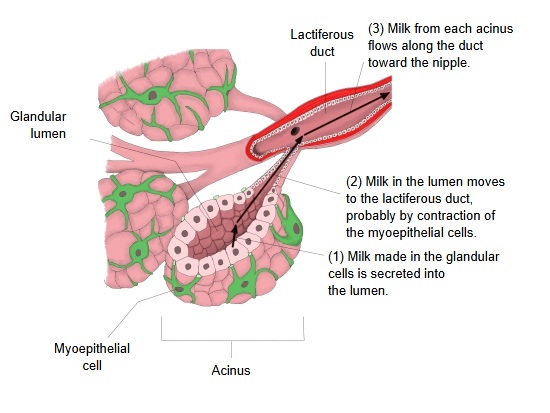
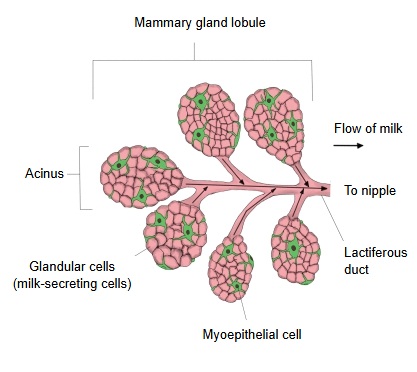
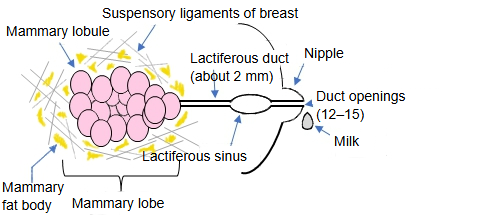
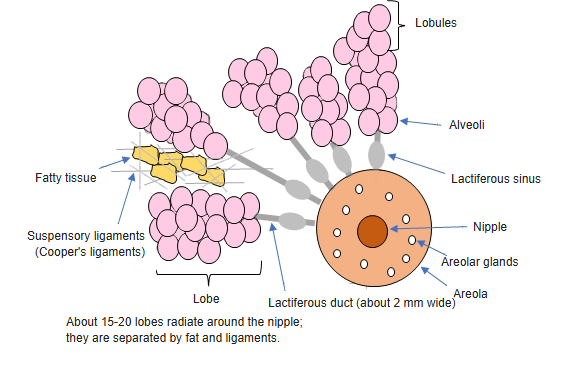
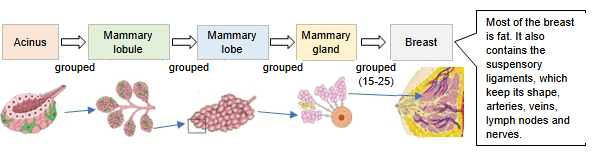
Breast milk is produced in the glandular acini inside the lobes of the mammary gland and leaves through the lactiferous ducts at the nipple.
The lobes, about 15 to 25 in number, are arranged radially around the areola.
After childbirth the mother secretes milk to feed the infant, under the control of hormones.
Mainly prolactin (milk production) and oxytocin (milk ejection).
· During lactation the glandular cells carry out active apocrine secretion; large fat droplets are released into the gland lumen as milk fat globules. In the early period of secretion the milk also contains colostrum corpuscles.
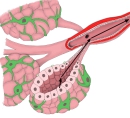 Production and transport of milk
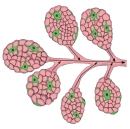 Flow of breast milk
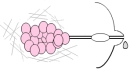 Lobes of the mammary gland (model 1)
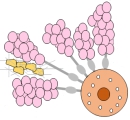 Lobes of the mammary gland (model 2)
Composition
About 88% of breast milk is water. Among the nutrients, carbohydrate is the largest part, followed by fat.
Carbohydrate: about 7%Fat: about 4.5%
| Group | Component | Typical value (g per 100 ml) |
|---|---|---|
| Fat (about 4.5%) | Free fatty acids | very small |
| Protein (about 1%) | Casein | 0.4 |
| Alpha-lactalbumin | 0.3 | |
| Lactoferrin (apolactoferrin) | 0.2 | |
| Immunoglobulin A | 0.1 | |
| Immunoglobulin G | 0.001 | |
| Lysozyme | 0.05 | |
| Albumin | 0.05 | |
| Beta-lactoglobulin | none | |
| Carbohydrate (about 7%) | Lactose (milk sugar) | 7 |
| Oligosaccharides | 0.5 | |
| Minerals | Calcium | 0.03 |
| Phosphorus | 0.014 | |
| Sodium | 0.015 | |
| Potassium | 0.055 | |
| Chlorine (chloride) | 0.043 |
· Unlike cow's milk, breast milk contains no beta-lactoglobulin, a common cause of cow's milk allergy.
Related terms
References and sources
- Further reading: Breast milk, Wikipedia.
- Federative International Programme for Anatomical Terminology (FIPAT). Terminologia Anatomica, 2nd ed. (TA2), 2019.