Glandular lumen
Also called the lumen of gland
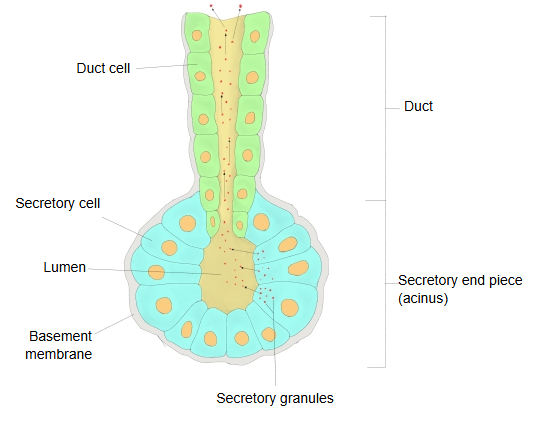
· The term is used in general descriptions of glands for the central space of a secretory end piece. Secretory cells store their product in secretory granules; when the granules are released at the cell's free (apical) surface, the secretion collects in the lumen.
· The lumen continues into the lumen of the duct, which carries the secretion to the body surface (for example sweat) or into a hollow organ (for example saliva into the mouth). Its size varies with the type of gland: it is narrow in serous end pieces such as those of the pancreas and wider in mucous end pieces. Endocrine glands have no lumen or duct; they release their hormones into the blood.
Reference websites
[Wikipedia]
· Gland, Wikipedia.
· Exocrine gland, Wikipedia.
[Websites with illustrations]
· Endocrine glands vs exocrine glands (Teachoo)

· Epithelial tissue: glandular epithelium (Anatomy & Physiology (Oregon State University))
Related terms
- Acinar lumen
- Glandular cell
- Exocrine gland
- Endocrine gland
- Serous gland
- Sweat gland
- Salivary glands
- Pancreas
References and sources
- Further reading: Gland, Wikipedia.
- Federative International Programme for Anatomical Terminology (FIPAT). Terminologia Anatomica, 2nd ed. (TA2), 2019.