Glenoid cavity (Latin: cavitas glenoidalis)
Also called the glenoid fossa
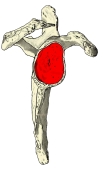 Right scapula (lateral)
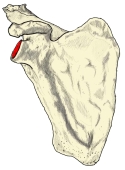 Glenoid cavity (red)
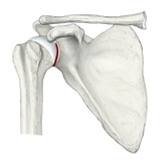 Right shoulder (glenohumeral joint, anterior view)
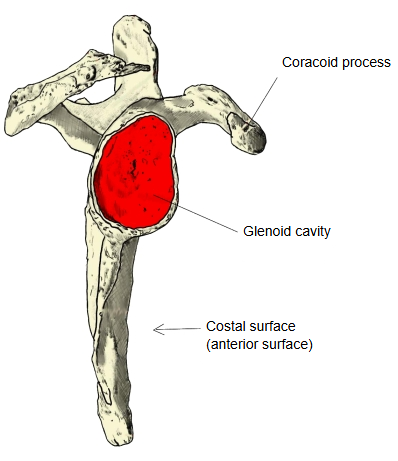
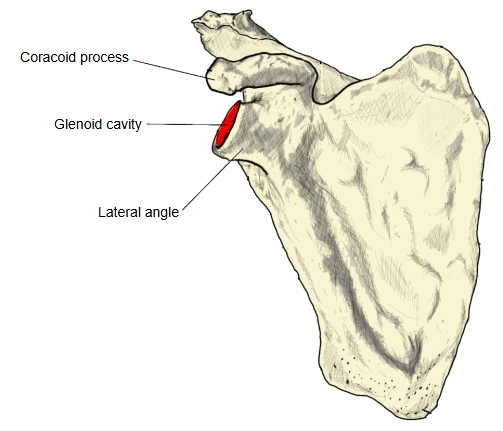
The lateral angle of the scapula looks as if its end had been cut off obliquely; here the large glenoid cavity, which articulates with the humerus, forms a shallow, pear-shaped hollow.
It faces laterally and slightly forwards. It is broader below than above, and its vertical diameter is the longest.
It is covered with articular cartilage, and its slightly raised rim gives attachment to the fibrocartilaginous glenoid labrum, which deepens the socket. A tear of the upper labrum where the biceps tendon attaches is called a SLAP lesion.
The supraglenoid tubercle (long head of biceps brachii) lies just above it and the infraglenoid tubercle (long head of triceps brachii) just below it. It is joined to the rest of the bone by the neck of the scapula.
It is much shallower than the acetabulum of the hip, so the glenohumeral joint depends on the rotator cuff and ligaments for its stability and dislocates more easily.
Where it is found
Related terms
- Glenohumeral joint
- Lateral angle of scapula
- Supraglenoid tubercle
- Infraglenoid tubercle
- Neck of scapula
- Coracoid process
- Humerus
References and sources
- Further reading: Glenoid fossa, Wikipedia.
- Federative International Programme for Anatomical Terminology (FIPAT). Terminologia Anatomica, 2nd ed. (TA2), 2019.