Lateral angle of scapula (Latin: angulus lateralis scapulae)
Also called the head of the scapula
· In some sources the lateral angle includes the glenoid cavity, the supraglenoid tubercle, the infraglenoid tubercle, the neck of the scapula and the coracoid process.
· Note: sources differ on its extent. Most English illustrations show the lateral angle without the coracoid process, so the illustration below also leaves the coracoid process out.
the scapula
- Superior angle : : the upper medial one of the three angles
- Inferior angle : : the lowest of the three angles
- Lateral angle : : the upper lateral one of the three angles
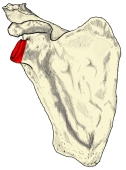 Lateral angle (red)
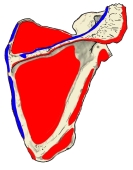 Muscle attachments (posterior)
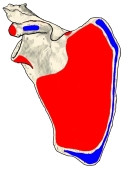 Muscle attachments (anterior)
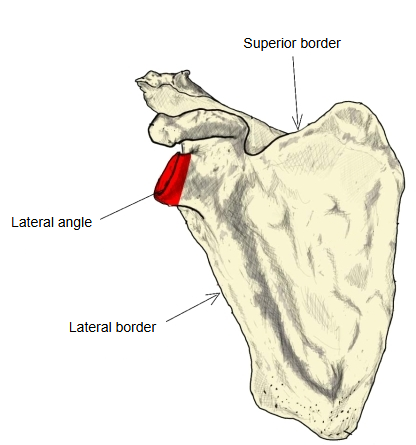
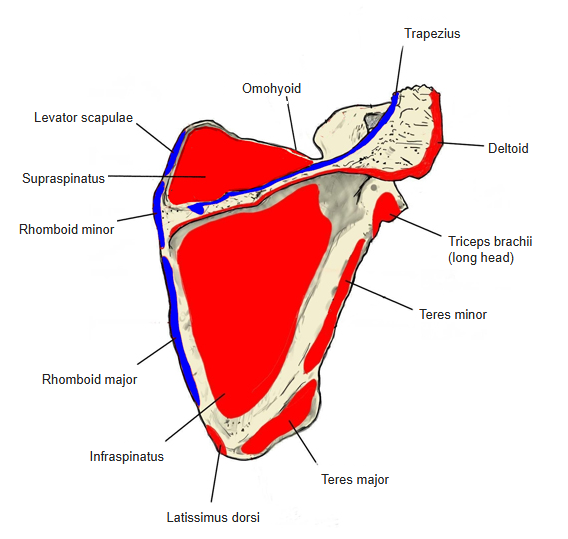
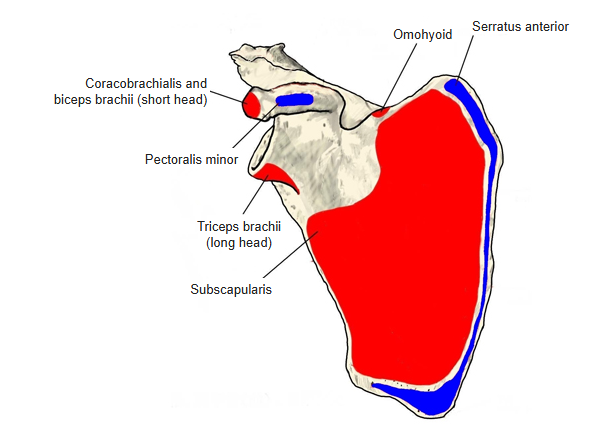
The lateral angle is the thickest part of the scapula. Unlike the other two angles, it is not a simple corner between two straight borders: the glenoid cavity makes it broad and blunt.
It carries the shallow, pear-shaped glenoid cavity, with which the head of the humerus articulates. Above and below the glenoid cavity the bone forms the supraglenoid tubercle and the infraglenoid tubercle, from which the long heads of biceps brachii and triceps brachii arise. The base of the glenoid cavity is slightly narrowed; this is the neck of the scapula. Above and in front of the glenoid cavity is the coracoid process, from which coracobrachialis and the short head of biceps brachii arise and on which pectoralis minor inserts.
Reference websites
[Wikipedia]
· Scapula, Wikipedia.
[Websites with illustrations]
· Head of the scapula (lateral angle) shown in red (Wikimedia Commons)

· Left scapula, posterior surface (Gray's Anatomy, fig. 203) (Wikimedia Commons)

Where it is found
Related terms
- Glenoid cavity
- Supraglenoid tubercle
- Infraglenoid tubercle
- Neck of scapula
- Coracoid process
- Superior angle of scapula
- Inferior angle of scapula
References and sources
- Further reading: Scapula, Wikipedia.
- Federative International Programme for Anatomical Terminology (FIPAT). Terminologia Anatomica, 2nd ed. (TA2), 2019.