Pronator tuberosity (Latin: tuberositas pronatoria)
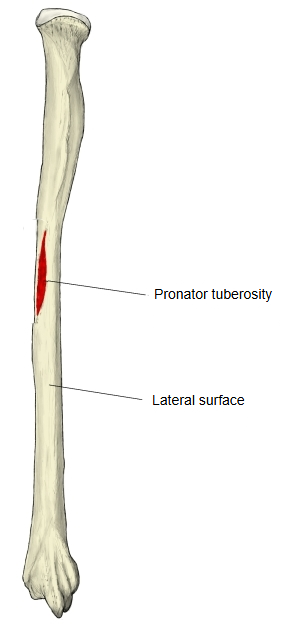
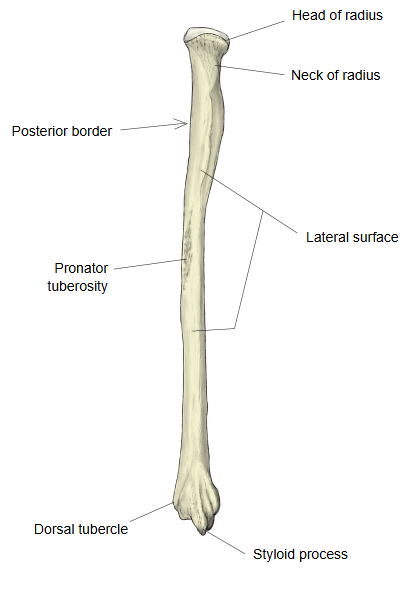
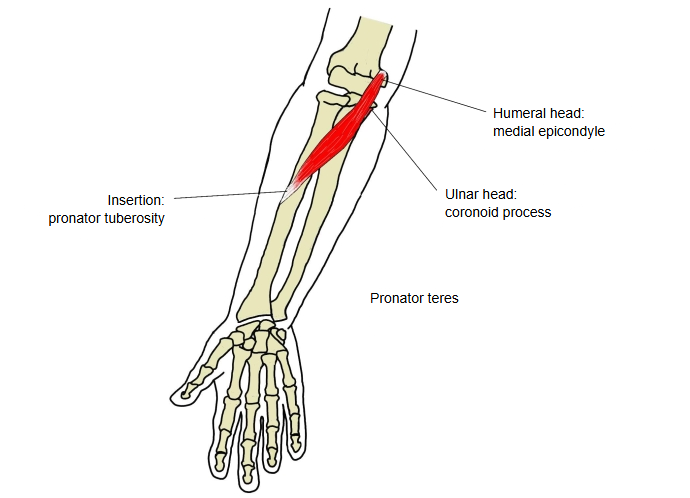
It is a roughened, usually oval impression rather than a distinct bump, on the lateral surface of the shaft at its point of greatest lateral curvature, just below the insertion of supinator. Pronator teres reaches it from two heads, a humeral head from the medial epicondyle and an ulnar head from the coronoid process. Because the muscle pulls on the outermost point of the curved radius, it swings the radius across the ulna at the proximal and distal radioulnar joints and turns the forearm palm-down (pronation).
 Right radius (lateral)
 Right radius (lateral)
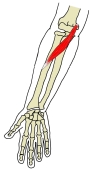 Right pronator teres
Reference websites
[Wikipedia]
· Radius (bone), Wikipedia.
· Pronator teres muscle, Wikipedia.
[Websites with illustrations]
· Bones of the left forearm, anterior aspect (Gray's Anatomy, fig. 212) (Wikimedia Commons)

· The radius: proximal, shaft and distal parts (TeachMeAnatomy)
· Pronator teres: origin, insertion, innervation, action (Kenhub)
Where it is found
Related terms
- Lateral surface of radius
- Body of radius
- Radial tuberosity
- Anterior border of radius
- Posterior border of radius
- Proximal radioulnar joint
- Distal radioulnar joint
References and sources
- Further reading: Radius (bone), Wikipedia.
- Further reading: Pronator teres muscle, Wikipedia.
- Federative International Programme for Anatomical Terminology (FIPAT). Terminologia Anatomica, 2nd ed. (TA2), 2019.