Posterior process of talus (Latin: processus posterior tali)
One of the two processes of the talus. It lies at the back of the body of the talus and is divided by the groove for the tendon of flexor hallucis longus into a medial tubercle and a lateral tubercle.
- Lateral process of talus
- Posterior process of talus
- Medial tubercle : attachment of the deltoid ligament (posterior tibiotalar part) and the medial talocalcaneal ligament.
- Groove for tendon of flexor hallucis longus : between the two tubercles.
- Lateral tubercle : attachment of the posterior talofibular ligament and the posterior talocalcaneal ligament.
Anatomy textbooks describe it as follows.
It is a broad process just below the back edge of the trochlea of the talus. It consists of the medial tubercle and the lateral tubercle, with the groove for the tendon of flexor hallucis longus between them. Its upper surface faces the back of the ankle; its lower surface carries the back part of the posterior calcaneal articular surface. A lateral tubercle that never fuses with the talus forms a separate small bone, the os trigonum; a large posterior process can be pinched in forced plantar flexion (posterior ankle impingement).
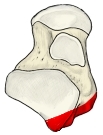 Right talus, posterior process (inferior)
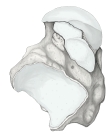 Right talus (inferior)
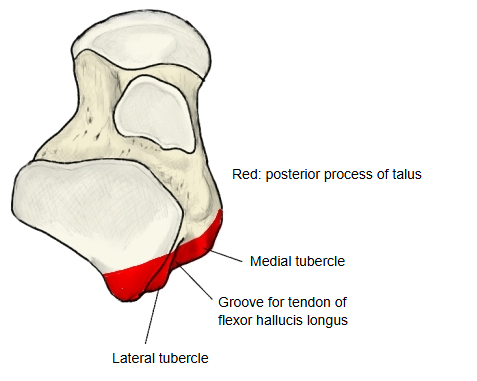
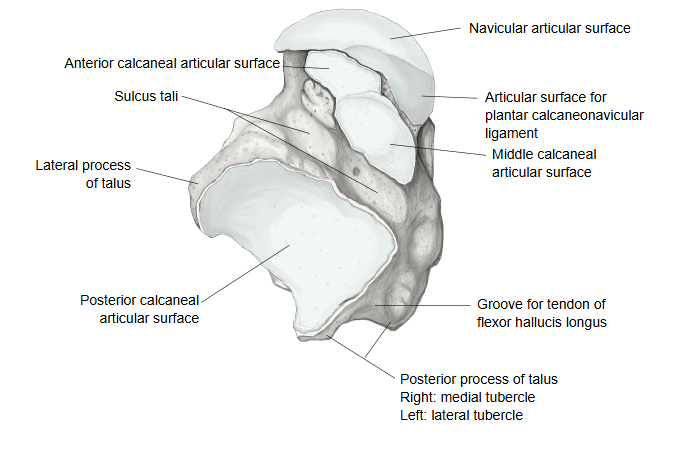
Ligaments
Four ligaments are attached to the posterior process of the talus.
| Tubercle | Ligament | |
|---|---|---|
| 1 | Lateral tubercle | Posterior talofibular ligament |
| 2 | Posterior talocalcaneal ligament | |
| 3 | Medial tubercle | Deltoid ligament (posterior tibiotalar part) |
| 4 | Medial talocalcaneal ligament |
Reference websites
[Wikipedia]
· Talus bone, Wikipedia.
[Websites with illustrations]
· Bones of the foot: tarsals, metatarsals and phalanges (TeachMeAnatomy)
· Talus: anatomy and clinical aspects (Kenhub)
Where it is found
Related terms
- Medial tubercle of talus
- Lateral tubercle of talus
- Groove for tendon of flexor hallucis longus
- Lateral process of talus
- Body of talus
- Trochlea of talus
- Os trigonum
References and sources
- Further reading: Talus bone, Wikipedia.
- Federative International Programme for Anatomical Terminology (FIPAT). Terminologia Anatomica, 2nd ed. (TA2), 2019.