Posterior calcaneal articular surface (Latin: facies articularis calcanea posterior)
Also called the posterior calcaneal facet of talus
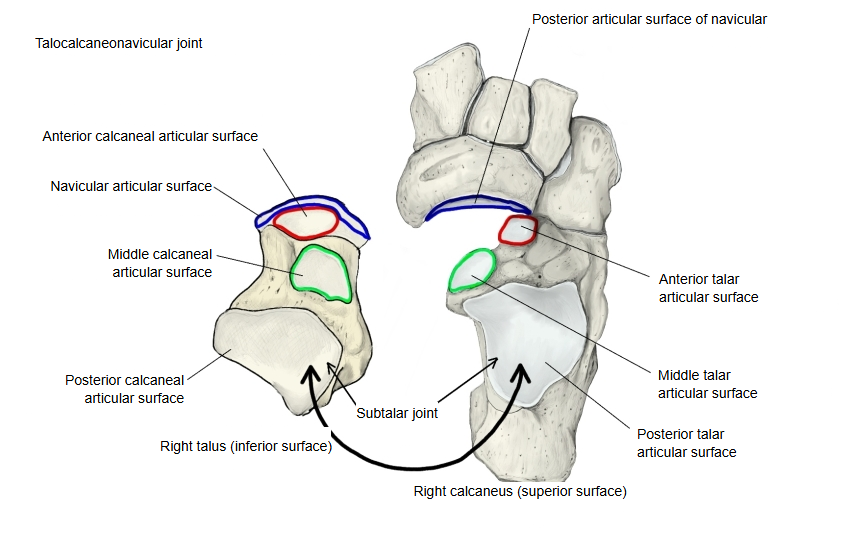
The articular surface on the underside of the talus that faces the posterior talar articular surface of the calcaneus; together they form the subtalar joint.
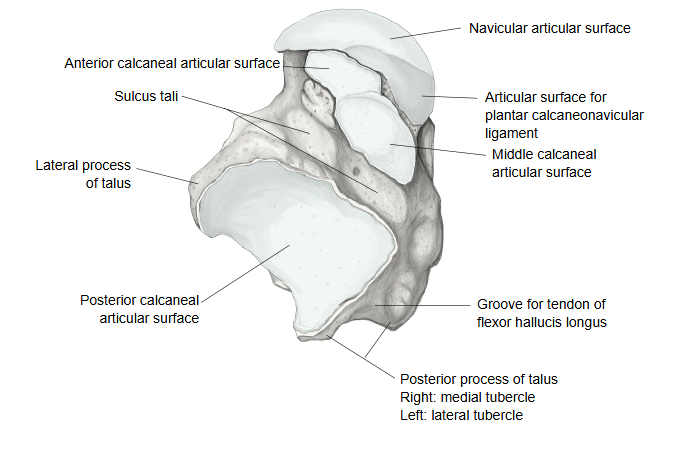
It is the largest articular surface on the underside of the talus: oval and concave, with its long axis running obliquely forwards and laterally. The sulcus tali separates it from the middle calcaneal articular surface in front (the anterior calcaneal articular surface lies further forward). Its lateral edge extends onto the underside of the lateral process; behind, it reaches the posterior process.
Sources differ in naming: some use "subtalar joint" (talocalcaneal joint) for this joint alone, others for the whole talocalcaneal complex including the talocalcaneonavicular joint.
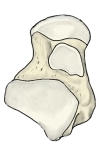 Right talus, calcaneal facets (inferior)
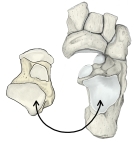 Right talus and calcaneus, opened out
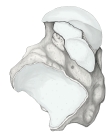 Right talus (inferior)
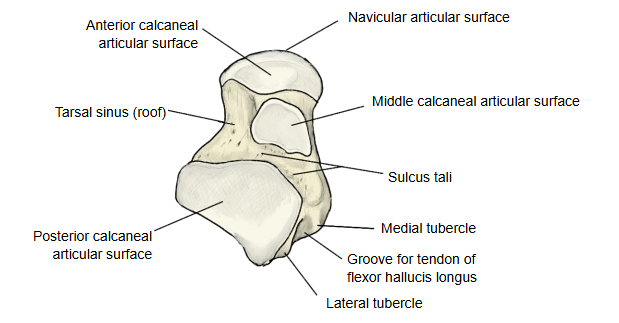
Sites with illustrations and photos
· Left talus, seen from below (Gray's Anatomy, Wikimedia Commons)

· Talus, inferior view: photo of a bone specimen (Wikimedia Commons)

Where it is found
Related terms
- Posterior talar articular surface
- Subtalar joint
- Sulcus tali
- Middle calcaneal articular surface
- Anterior calcaneal articular surface
- Lateral process of talus
References and sources
- Further reading: Talus bone, Wikipedia.
- Further reading: Subtalar joint, Wikipedia.
- Federative International Programme for Anatomical Terminology (FIPAT). Terminologia Anatomica, 2nd ed. (TA2), 2019.