Thorax (Latin: thorax; compages thoracis)
Also called the thoracic cage or the rib cage or the chest
In other words, the thorax (thoracic cage) is the bony framework of the thoracic cavity. It is narrow above and wide below, flattened from front to back, and moves with breathing. Sources differ in usage: "thorax" may mean the whole chest region or only its skeleton, the thoracic cage.
cage
- Thoracic vertebrae : all 12, from the 1st to the 12th thoracic vertebra.
- Ribs : all 12 pairs, from the 1st to the 12th rib.
- Sternum : three parts: the manubrium, the body and the xiphoid process.
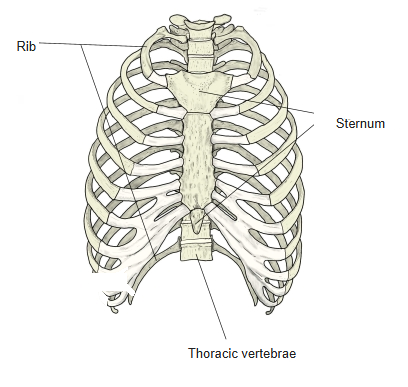
· The thorax has a large opening above and below. The upper one is the superior thoracic aperture (often called the thoracic inlet). It is bounded by the body of the 1st thoracic vertebra, the 1st ribs with their cartilages and the upper border of the manubrium. It slopes downwards and forwards, and structures pass through it between the neck and the thorax.
· The lower one is the much wider inferior thoracic aperture. It is bounded by the body (lower border) of the 12th thoracic vertebra, the 11th and 12th ribs, the costal cartilages of the 7th to 10th ribs and the xiphoid process of the sternum (at the xiphisternal joint). It is closed by the diaphragm. Anatomists often call it the thoracic outlet, but clinicians use that name for the upper opening, so sources differ.
 Thoracic cage (anterior)
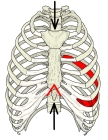 Thoracic apertures and costal arches
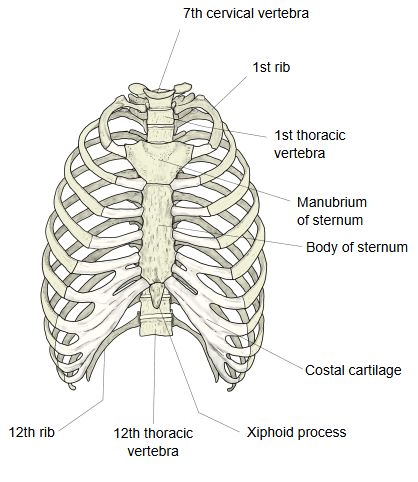
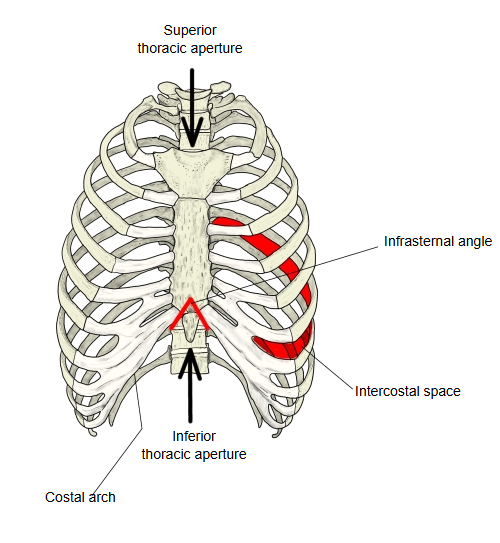
The cartilages of the 7th to 10th ribs (the 8th to 10th each joining the one above) form an arched lower edge on each side, the costal arch (costal margin). The right and left costal arches meet at the lower end of the sternum, on either side of the xiphoid process, at an angle of roughly 70°, the infrasternal angle; the angle varies with body build. The gaps between neighbouring ribs are the 11 intercostal spaces. They become narrower from above downwards, are wider in front than behind, and are widest near the junctions of the ribs with their costal cartilages.
The space enclosed by the thoracic vertebrae, the ribs and the sternum is the thoracic cavity. It is something quite different from the pleural cavity, the narrow space between the two layers of pleura around each lung, and the two should not be confused.
In the wider sense, the thorax is the upper part of the trunk between the neck and the abdomen. Its wall is formed by the thoracic vertebrae, the ribs and the sternum together with the muscles and fasciae attached to them. Below, the diaphragm separates it from the abdomen, and it contains the chief organs of the circulatory and respiratory systems.
Reference websites
[Wikipedia]
· Rib cage, Wikipedia.
· Thoracic cavity, Wikipedia.
[Websites with illustrations]
· The ribcage (TeachMeAnatomy)
· The sternum (TeachMeAnatomy)
Where it is found
Related terms
References and sources
- Further reading: Thoracic cavity, Wikipedia.
- Further reading: Rib cage, Wikipedia.
- Federative International Programme for Anatomical Terminology (FIPAT). Terminologia Anatomica, 2nd ed. (TA2), 2019.