Adductor hiatus (Latin: hiatus adductorius)
Also called: tendinous hiatus; adductor tendinous opening
 Adductor muscles and adductor hiatus
 Vessels passing through the hiatus
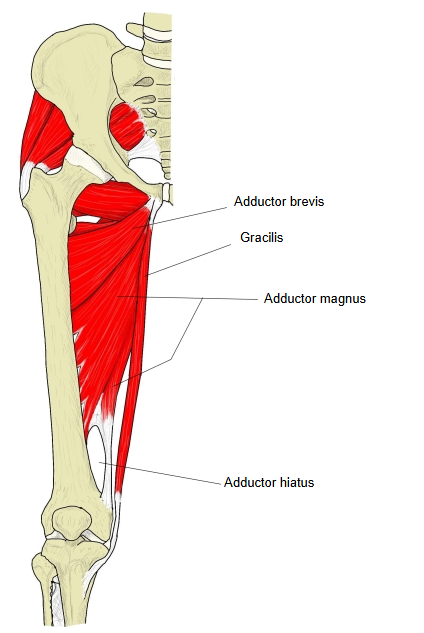
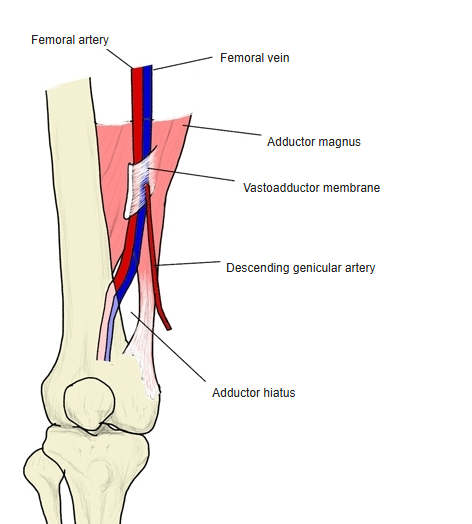
It is the gap between the tendon of the adductor magnus and the femur, just above the knee, through which the femoral vessels pass from the front of the thigh to the popliteal fossa. It is the lower end of the adductor canal and lies about 8–13.5 cm above the adductor tubercle (sources differ). It is bounded laterally by the femur and medially by the adductor magnus, between its adductor part and its tendinous (hamstring) part inserting on the adductor tubercle. Its upper edge may be an oval arch or a bridge, and its wall muscular or fibrous. The saphenous nerve and the saphenous branch of the descending genicular artery do not pass through the hiatus; they leave the canal near its lower end by piercing the vastoadductor membrane.
Reference websites
[Wikipedia]
· Adductor hiatus, Wikipedia.
· Adductor canal, Wikipedia.
Related terms
- Adductor canal
- Vastoadductor membrane
- Tendinous adductor canal
- Adductor magnus
- Adductor tubercle
- Femoral artery
- Popliteal artery
References and sources
- Further reading: Adductor hiatus, Wikipedia.
- Further reading: Adductor canal, Wikipedia.
- Federative International Programme for Anatomical Terminology (FIPAT). Terminologia Anatomica, 2nd ed. (TA2), 2019.