Anterior tubercle of cervical vertebra (Latin: tuberculum anterius vertebrae cervicalis)
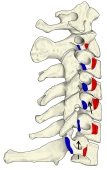 Cervical vertebrae, side view
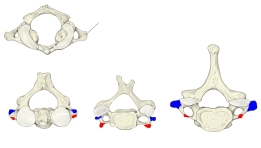 Atlas, axis, C4 and C7 from above
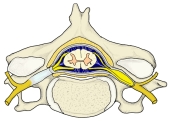 Spinal nerve and cervical vertebra
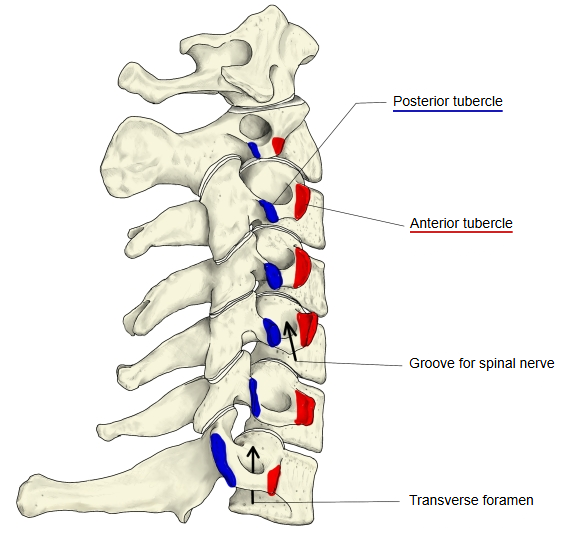
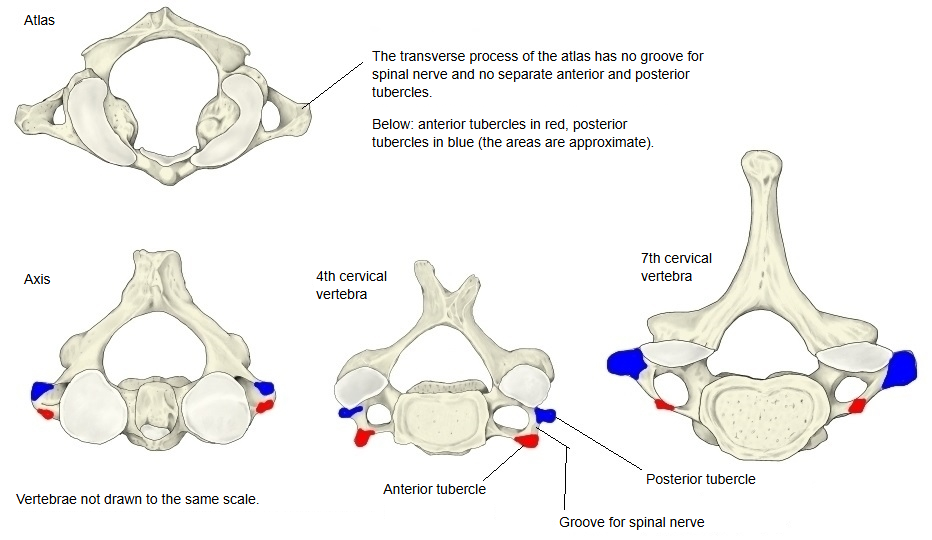
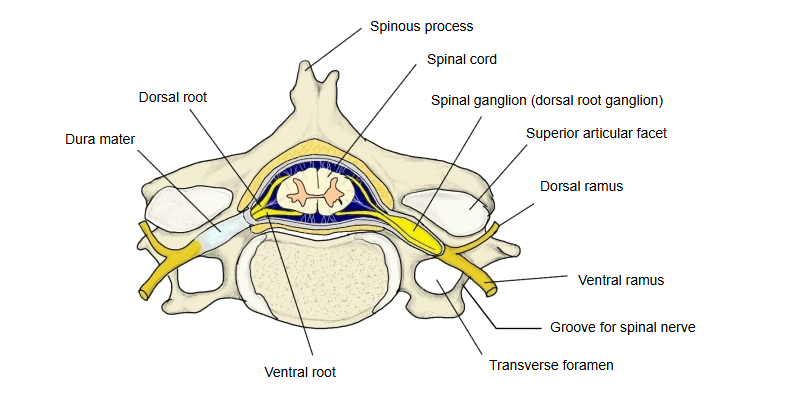
In the transverse process the parts in front of and behind the transverse foramen both thicken slightly at their ends: the front one forms the anterior tubercle, which corresponds to a rib, and the back one forms the posterior tubercle, which corresponds to the transverse process proper.
In the 2nd to 7th cervical vertebrae the transverse foramen splits the root of the transverse process into a front and a back part. The part behind the foramen, ending in the posterior tubercle, is the true transverse process.
The front part is the counterpart of a rib in the thoracic region and is therefore called the costal process (costal element). It arises from the side of the vertebral body, passes laterally in front of the transverse foramen and ends in the anterior tubercle. The anterior tubercles give attachment to the anterior scalene, longus capitis and longus colli; the large anterior tubercle of C6 is called the carotid tubercle.
Reference websites
[Wikipedia]
· Cervical vertebrae, Wikipedia.
[Websites with illustrations]
· A cervical vertebra (Gray's Anatomy, fig. 84) (Wikimedia Commons)

· Side view of a cervical vertebra (Gray's Anatomy, fig. 85) (Wikimedia Commons)

· Cervical spine: anatomy, ligaments, nerves and injury (Kenhub)
Related terms
- Transverse process
- Costal process
- Transverse foramen
- Groove for spinal nerve
- Uncinate process of cervical vertebra
- Cervical vertebrae
References and sources
- Further reading: Cervical vertebrae, Wikipedia.
- Federative International Programme for Anatomical Terminology (FIPAT). Terminologia Anatomica, 2nd ed. (TA2), 2019.