Groove for spinal nerve (Latin: sulcus nervi spinalis)
A groove on the transverse process of the 3rd to 7th cervical vertebrae, along which a spinal nerve passes.
It is not found in typical form on the first and second cervical vertebrae (atlas and axis).The spinal nerve leaves through the intervertebral foramen (the gap between the superior and inferior vertebral notches), passes beyond the transverse foramen and is led into the groove.
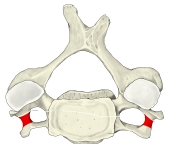 Cervical vertebra (superior view)
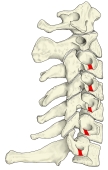 Cervical vertebrae (anterolateral view)
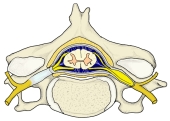 Spinal nerve and cervical vertebra
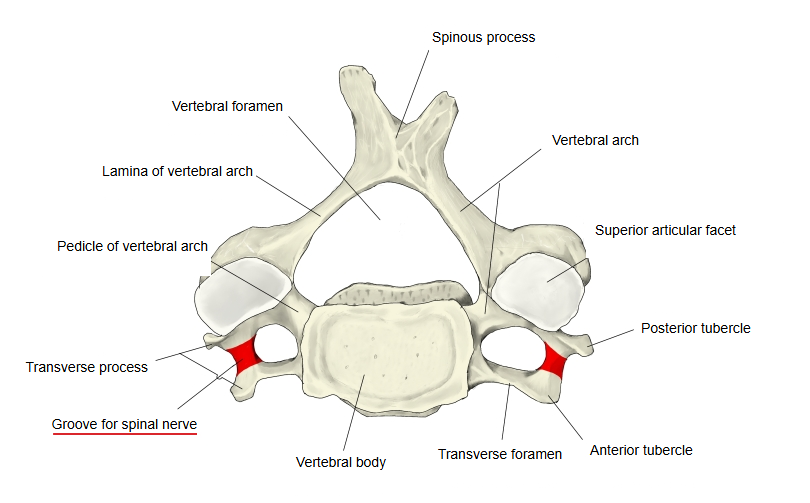
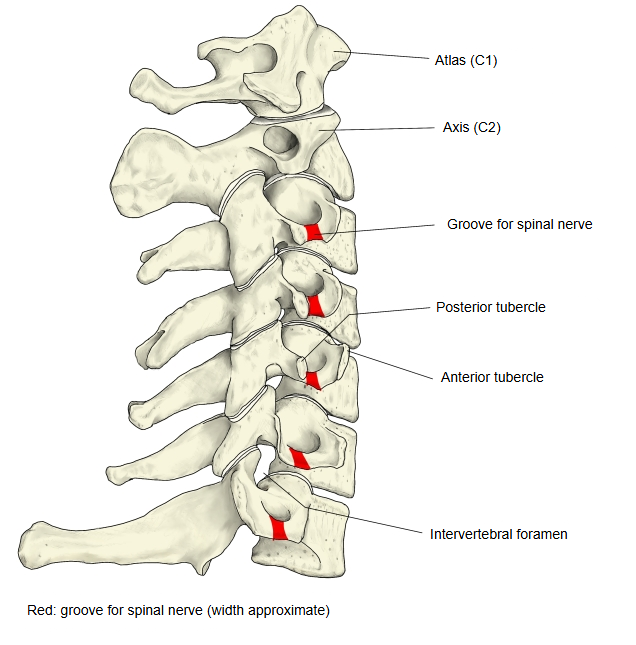
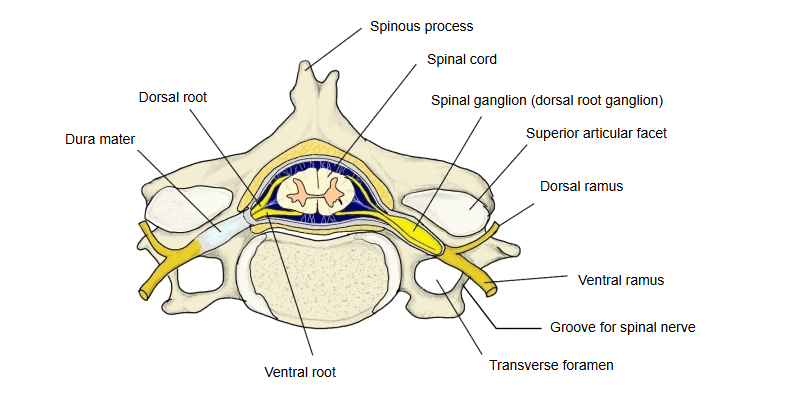
The groove runs laterally on the upper surface of the transverse process, between its anterior and posterior tubercles and lateral to the transverse foramen; the emerging spinal nerve lies in it.
The nerve passes behind the vertebral artery, which runs up through the transverse foramina, and then follows the groove, dividing into its ventral and dorsal rami. The groove is a common landmark for nerve blocks of the brachial and cervical plexuses in the neck.
Related terms
- Vertebral canal
- Vertebral cavity
- Medullary cone
- Vertebral region
- Erector spinae
- Cervical vertebrae
- Transverse process
- Transverse foramen
- Spinal nerves
- Spinal ganglion
- Uncinate process of cervical vertebra
References and sources
- Further reading: Cervical vertebrae, Wikipedia.
- Federative International Programme for Anatomical Terminology (FIPAT). Terminologia Anatomica, 2nd ed. (TA2), 2019.