Bone lacuna (Latin: lacuna ossea)
Also called osteocyte lacuna or lacuna (of bone)
Bone lacuna
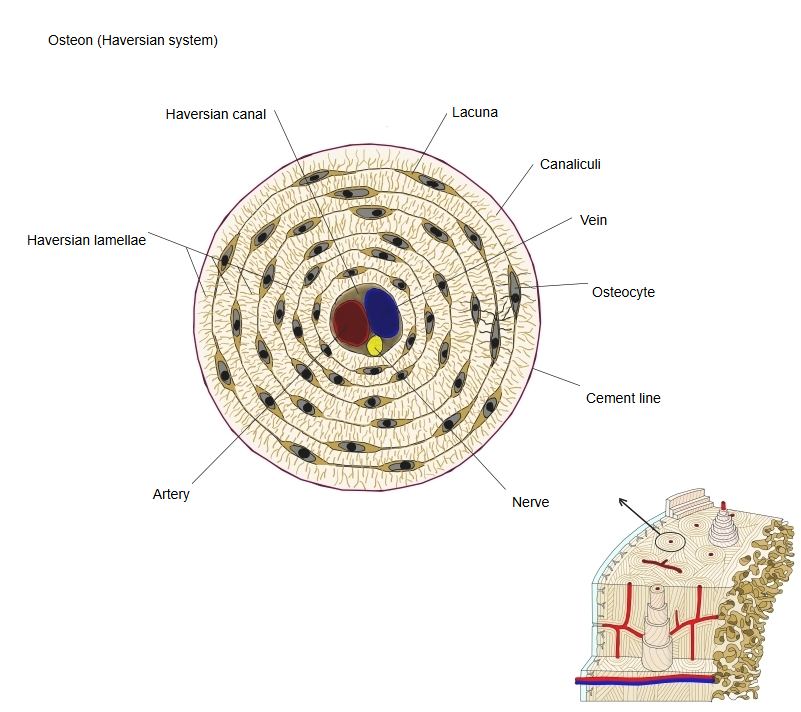
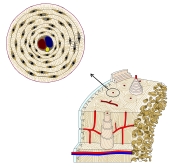 Osteon (cross section)
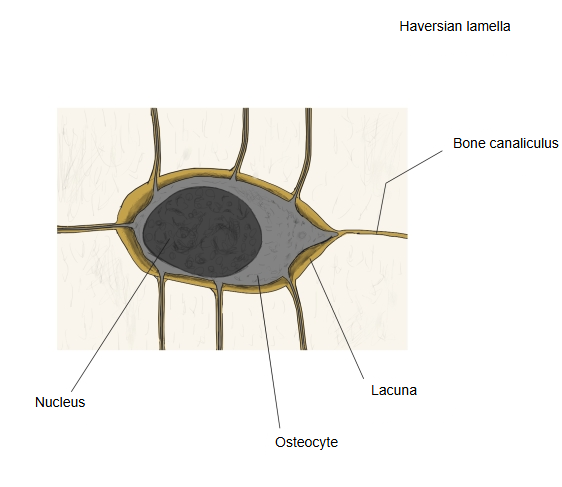
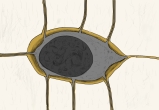 Osteocyte in its lacuna
In older textbooks the bone lacunae are also called bone corpuscles.
The osteocytes lie in spaces inside the bone matrix, and each space closely follows the shape of its cell and the cell's processes. Lacunae lie between or within the bony lamellae, and each holds a single osteocyte. In dried bone the cells are gone, so the empty lacunae and canaliculi are easy to see under the microscope.
Most lacunae are lens-shaped, roughly 10-30 µm long (about 13-31 µm long, 6-15 µm wide and 4-9 µm thick). Fine channels, the bone canaliculi, run out from each lacuna in all directions and join those of neighbouring lacunae; the osteocyte processes lie in them. Some canaliculi open into the Haversian canals of the osteons, the medullary cavity and other spaces with blood vessels, and onto the outer surface of the bone. Through this network, nutrients and wastes pass between the osteocytes and the blood.
Other spaces are also called lacunae, for example the cartilage lacuna and the vascular lacuna below the inguinal ligament.
Reference websites
[Wikipedia]
· Lacuna (histology), Wikipedia.
[Websites with illustrations]
· Histology of bone (slide) (SlideShare)

· Lacunae in compact bone (Quia)

Related terms
References and sources
- Further reading: Lacuna (histology), Wikipedia.
- Federative International Programme for Anatomical Terminology (FIPAT). Terminologia Anatomica, 2nd ed. (TA2), 2019.