Cartilage lacuna
Also called Lacuna (of cartilage)
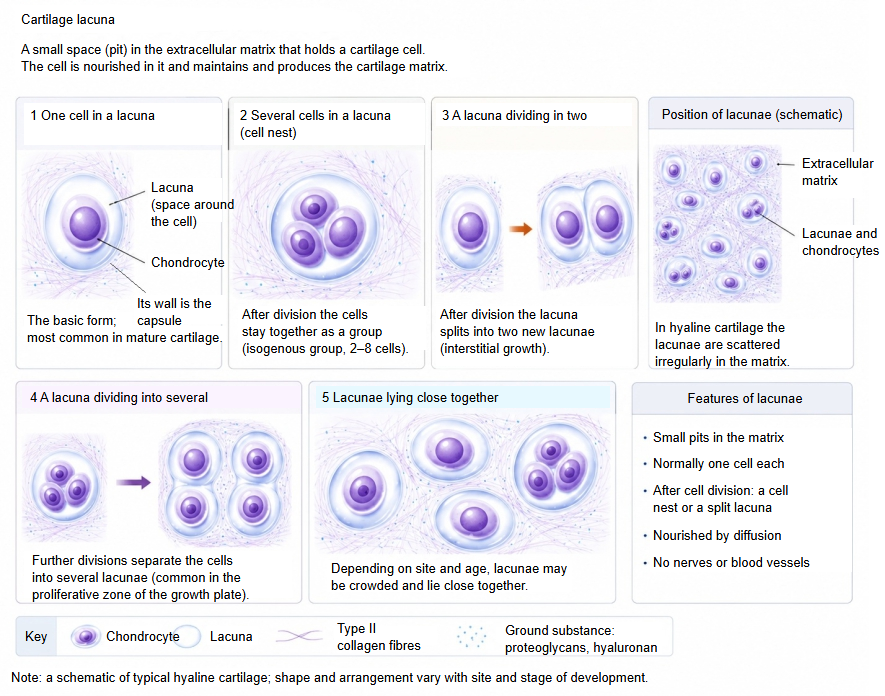
A cartilage lacuna is the capsule-shaped space in cartilage that holds a cartilage cell (chondrocyte).
Its size varies; sources give different rangesIn living tissue the chondrocyte fills its lacuna; the visible gap in sections is mostly shrinkage
The part forming the wall of the lacuna is called the cartilage capsule, and the substances secreted by the cell pass through it and spread into the whole cartilage.
Substances secreted: collagen fibres, proteoglycans and othersThe capsule (pericellular matrix) is rich in proteoglycans and fine collagen fibres
Usually one chondrocyte lies in each lacuna, but there may be several, and the lacuna itself may divide.
After division the daughter cells may stay together in one lacuna as an isogenous group (cell nest), or the lacuna splits into two or more new lacunae; this is interstitial growth. Cartilage has no nerves or blood vessels, so the cells in the lacunae are nourished by diffusion through the matrix from the perichondrium or the synovial fluid.
Related terms
- Cartilage
- Cartilage matrix
- Perichondrium
- Cartilaginous joint
- Articular cartilage
- Epiphyseal cartilage
- Costal cartilage
References and sources
- Further reading: Lacuna (histology), Wikipedia.
- Further reading: Chondrocyte, Wikipedia.
- Federative International Programme for Anatomical Terminology (FIPAT). Terminologia Anatomica, 2nd ed. (TA2), 2019.