Cartilage matrix
Also called the cartilaginous matrix or the extracellular matrix of cartilage
of
cartilage
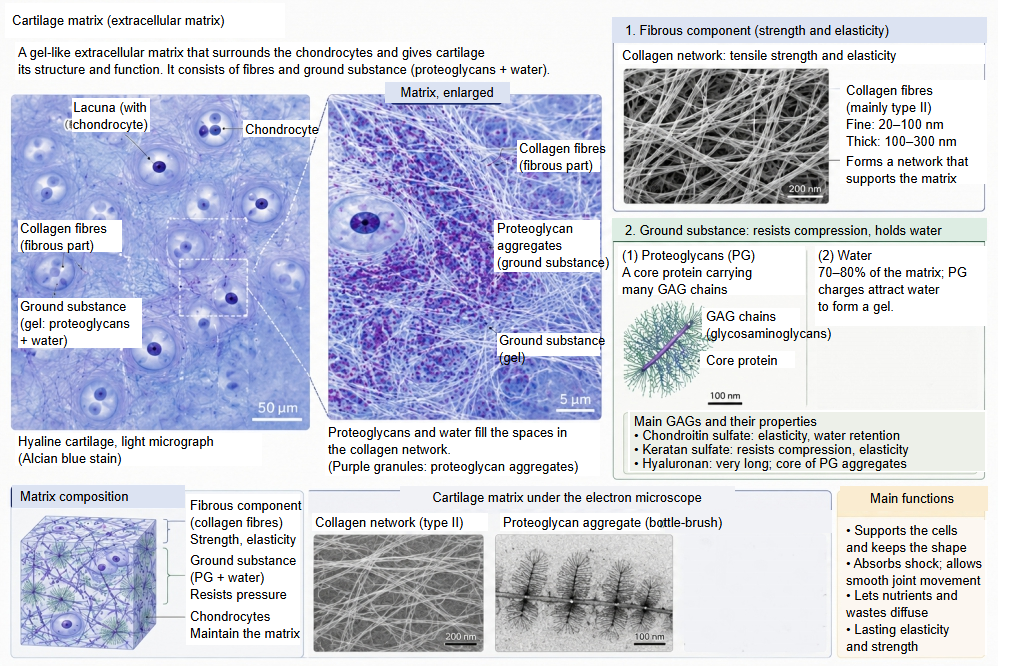
- Cartilage cells : chondrocytes: secrete the cartilage matrix (everything except the water) and maintain the function of cartilage; about 1–5% of the volume.
- Cartilage matrix : = extracellular matrix
- Fibrous component : mainly type II collagen (hyaline cartilage); also type I collagen (fibrocartilage) and elastic fibres (elastic cartilage).
- Ground substance : amorphous: proteoglycans (most of it), hyaluronan and glycoproteins.
- Water : about 60–80% of the matrix, held by the proteoglycans; important for the diffusion of nutrients and wastes.
· Fibrous component: the framework that keeps the shape of the tissue. Collagen gives tensile strength, and elastin gives the elasticity that returns the tissue to its original shape.
· Ground substance: the jelly-like material that fills the spaces between the fibres. Its proteoglycans carry many negative charges, so they attract water strongly and hold it, forming a firm gel that resists compression.
· Water: most of the cartilage matrix is water. It soaks in from the synovial fluid or from the vessels of the perichondrium. Because cartilage has no blood vessels, nutrients and wastes diffuse through this water to and from the cells in their lacunae.
| Category | Component | Differences between the types of cartilage | |
|---|---|---|---|
| 1 | Fibrous component | Type II collagen fibres | Hyaline: type II collagen makes up about 50–60% of the solid matter. Elastic: besides type II, a dense network of elastin. Fibrocartilage: very thick type I collagen fills the tissue. |
| Type I collagen fibres | |||
| Elastic fibres (elastin) | |||
| 2 | Ground substance | Proteoglycans (aggrecan and others) | Hyaline: very abundant (about 30% or more of the solid matter). Elastic: as abundant as in hyaline cartilage. Fibrocartilage: only a small amount in the spaces between the fibres. |
| Polysaccharide (hyaluronan) | Only a very small share of each cartilage (under 1%), but it helps to hold large amounts of water. | ||
| Other glycoproteins | Mainly act as glue: link protein, chondronectin and others. | ||
| 3 | Water | Tissue fluid | Most of the matrix in all three types (about 60–80%); fibrocartilage holds somewhat less. |
· Proteoglycans, chiefly aggrecan, consist of a core protein carrying many negatively charged glycosaminoglycan chains such as chondroitin sulfate and keratan sulfate. Many aggrecan molecules attach to a long hyaluronan chain to form large aggregates.
· The kind and amount of fibre in the matrix distinguishes the three types: hyaline cartilage (e.g. articular and costal cartilage) has fine type II collagen and abundant proteoglycans, so its matrix looks glassy and uniform; elastic cartilage (e.g. the auricle and the epiglottis) has a dense network of elastic fibres; fibrocartilage (e.g. the intervertebral disc and the pubic symphysis) has thick bundles of type I collagen with little ground substance.
Related terms
- Cartilage
- Symphysis
- Cartilage lacuna
- Perichondrium
- Articular cartilage
- Costal cartilage
- Epiphyseal cartilage
- Intervertebral disc
- Cartilaginous joint