Conus arteriosus (Latin: conus arteriosus)
Also called the infundibulum (of right ventricle)
What is the conus arteriosus?
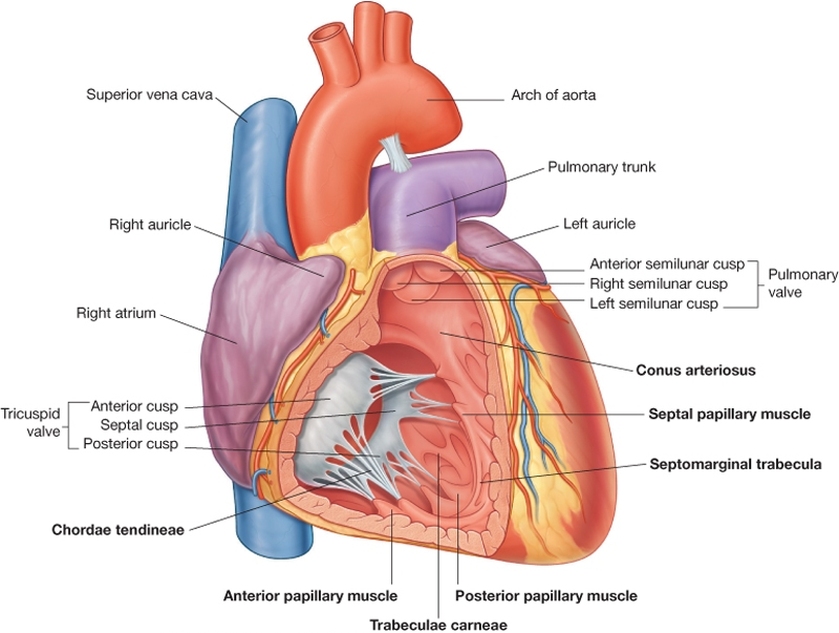
· The pulmonary trunk arises from the conus arteriosus of the right ventricle, at the pulmonary valve, behind the sternal end of the left third costal cartilage.
The conus arteriosus is the smooth-walled, funnel-shaped outflow part of the right ventricle before it opens into the pulmonary trunk. It forms the upper left part of the ventricle, just below the pulmonary valve. Unlike the rest of the ventricle, which is ridged by trabeculae carneae (trabeculae), its wall is smooth, and it is separated from the inflow part of the ventricle by the supraventricular crest. It develops from the bulbus cordis of the embryonic heart; abnormal development of this region is part of tetralogy of Fallot. Some sources use 'infundibulum' for the inner outflow tract and 'conus arteriosus' for its outer surface; in practice the two names are used for the same part.
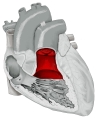 Conus arteriosus
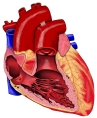 Heart (anterior view)
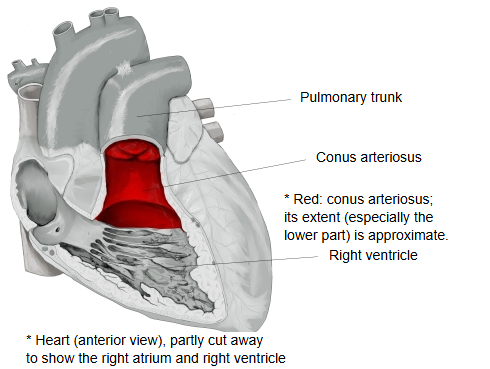
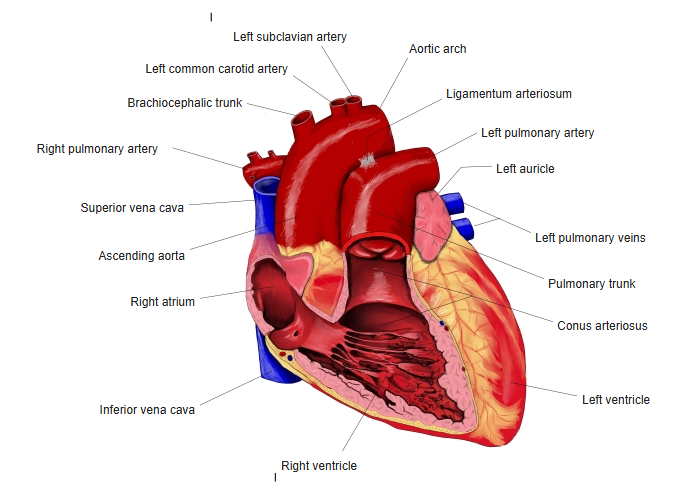
Reference websites
[Wikipedia]
· Infundibulum (heart), Wikipedia.
· Ventricle (heart), Wikipedia.
[Websites with illustrations]
· Interior of the right ventricle with the conus arteriosus, anterior view (figure) (cardiovascularsystemud.weebly.com)
Related terms
References and sources
- Further reading: Infundibulum (heart), Wikipedia.
- Further reading: Ventricle (heart), Wikipedia.
- Federative International Programme for Anatomical Terminology (FIPAT). Terminologia Anatomica, 2nd ed. (TA2), 2019.