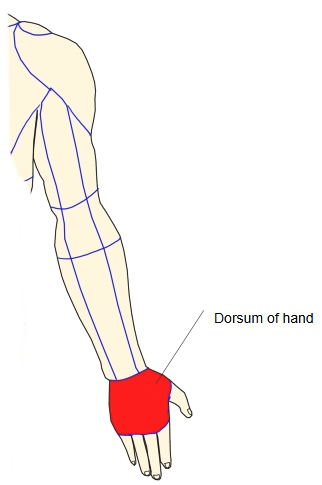
Dorsum of hand (Latin: dorsum manus)
Also called the back of the hand
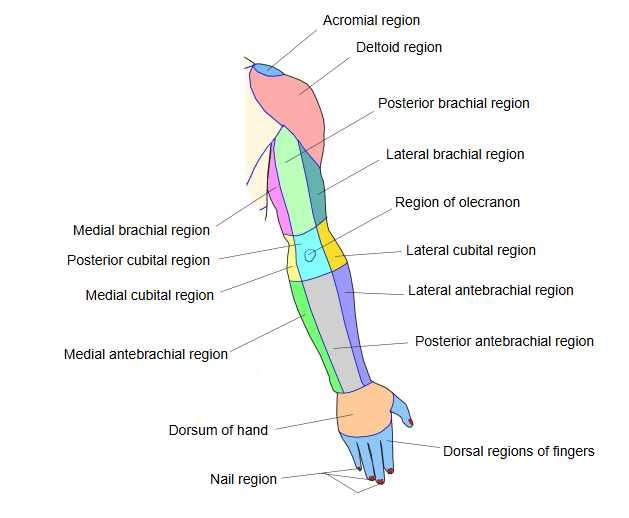
One of the regions of the body in anatomy: a part of the upper limb, the so-called back of the hand, between the wrist and the bases of the fingers.
- The region on the opposite side is the palm of the hand.
- There is a right and a left dorsum of hand.
Above, it continues from the posterior antebrachial region; below, it reaches the dorsal regions of the fingers. The skin is thin and loose, and through it the dorsal venous network of the hand and the tendons of extensor digitorum are easily seen over the metacarpal bones. Its skin is supplied by the superficial branch of the radial nerve (radial nerve) and the dorsal branch of the ulnar nerve (ulnar nerve).
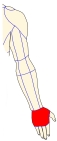 Dorsum of hand
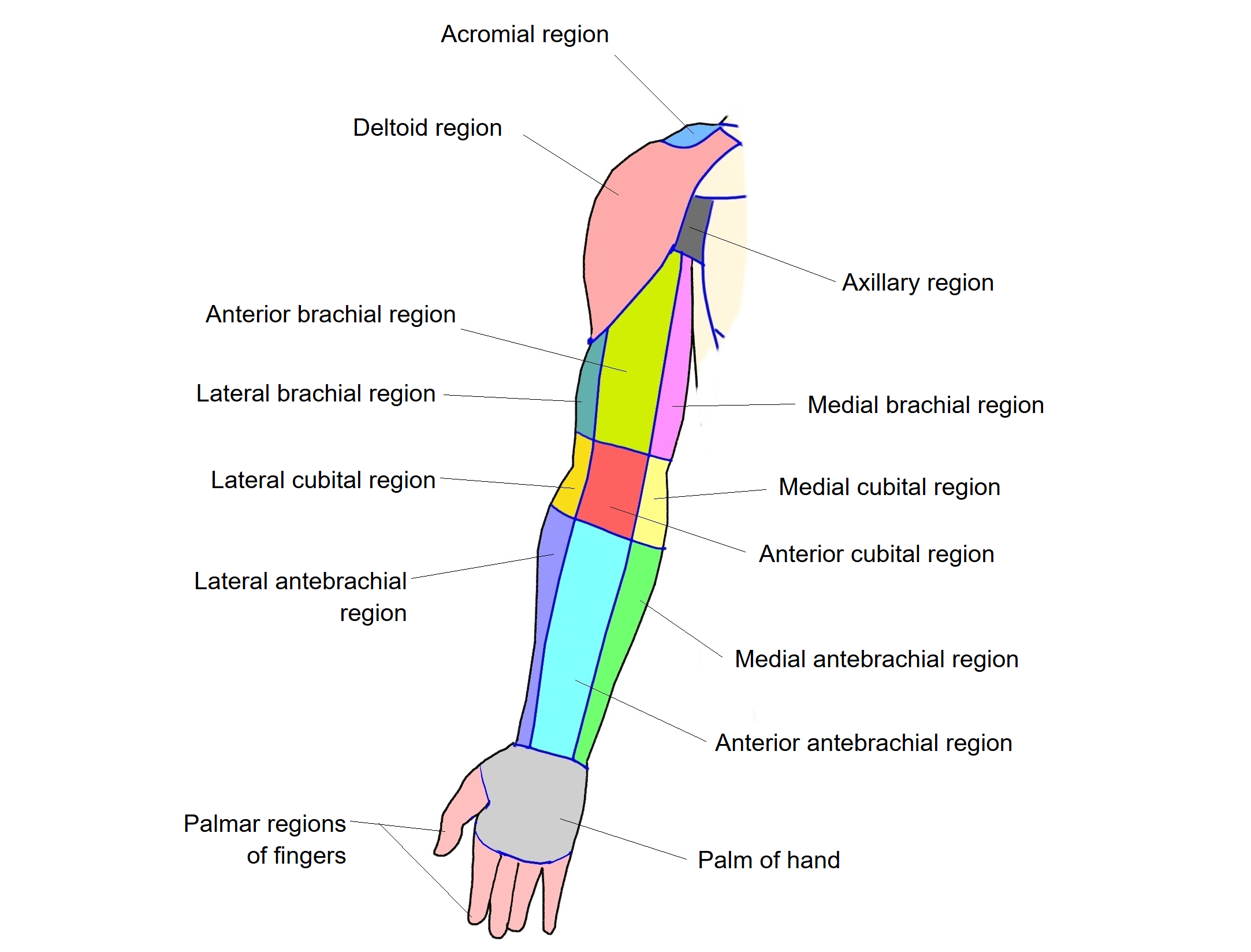
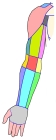 Regions of the upper limb (anterior)
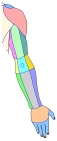 Regions of the upper limb (posterior)
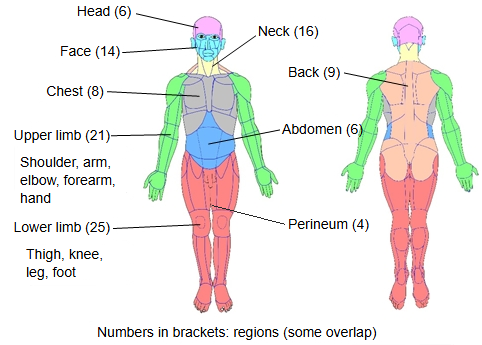
Parts of the body
- Head and neck : 1. head 2. face 3. neck
- Trunk : 1. chest 2. abdomen 3. back (9 regions, including the gluteal region)
- Perineum : 1. perineal region 2. anal region 3. urogenital region 4. pudendal region
- Limbs
- Upper limb : 1. shoulder 2. arm 3. elbow 4. forearm 5. hand (21 regions)
- Lower limb : 1. thigh 2. knee 3. leg 4. foot (25 regions)
Related terms
- Palm of hand
- Intrinsic muscles of hand
- Hypothenar muscles
- Bones of upper limb
- Posterior antebrachial region
- Dorsal venous network of the hand
- Extensor digitorum
- Metacarpal bones
- Dorsal interossei (hand)
- Dorsal digital expansion
- Superficial branch of radial nerve
References and sources
- Further reading: Hand, Wikipedia.
- Federative International Programme for Anatomical Terminology (FIPAT). Terminologia Anatomica, 2nd ed. (TA2), 2019.