Axillary region (Latin: regio axillaris)
The axillary region
It lies below and medial to the deltoid region, where the arm meets the side of the chest. Its surface hollow is the axillary fossa (armpit); beneath it lies the axilla, a pyramid-shaped space between the arm and the chest wall. The front wall of the axilla is formed mainly by pectoralis major, the back wall by latissimus dorsi, teres major and subscapularis, and the medial wall by serratus anterior over the ribs. The axilla is the main passage between the neck and the upper limb: it carries the axillary artery, the axillary vein, the cords and branches of the brachial plexus, and the axillary lymph nodes.
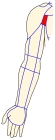 Axillary region
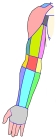 Regions of the upper limb
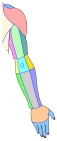 Regions of the upper limb (posterior)
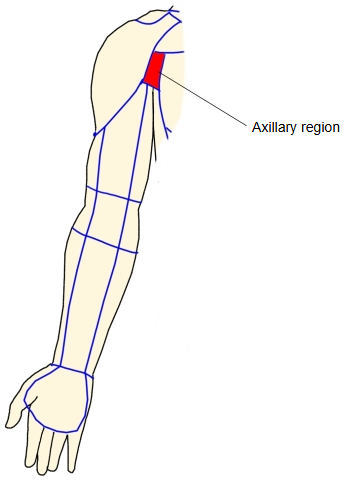
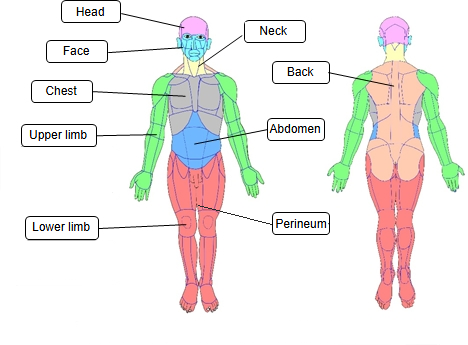
On this site the body is divided into three main parts, the head and neck, the trunk and the limbs, and the limbs into the upper and lower limbs. Each part is divided further into smaller regions.
of the
body
- Head and neck : 1. head (head, face) 2. neck
- Trunk : 1. chest 2. abdomen 3. back
- Limbs
- Upper limb : 1. shoulder 2. arm 3. elbow 4. forearm 5. hand
- Lower limb : 1. perineum 2. thigh 3. knee 4. leg 5. foot
Related terms
- Deltoid
- Pectoralis major
- Latissimus dorsi
- Serratus anterior
- Axillary artery
- Axillary vein
- Brachial plexus
References and sources
- Further reading: Axilla, Wikipedia.
- Federative International Programme for Anatomical Terminology (FIPAT). Terminologia Anatomica, 2nd ed. (TA2), 2019.