Palmar regions of fingers (Latin: regiones digitorum palmares)
Also called the palmar surfaces of the fingers
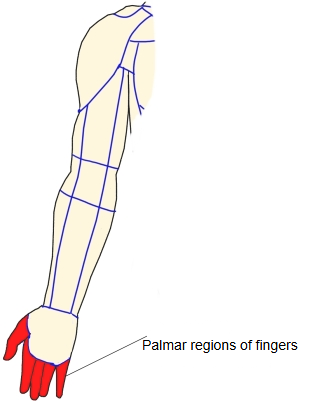
The palmar regions of the fingers
They lie distal to the palm of the hand; the matching regions on the back are the dorsal regions of the fingers. The skin here is thick and hairless, with the fingerprint ridges and the skin creases over the joints; the finger pads at the tips are rich in sensory nerve endings. Under the skin run the fibrous digital sheaths with the flexor tendons, and the palmar digital arteries and nerves along each side of the finger, over the bones of the hand (the phalanges).
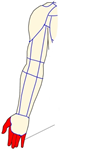 Palmar regions of fingers
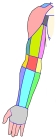 Regions of the upper limb (anterior)
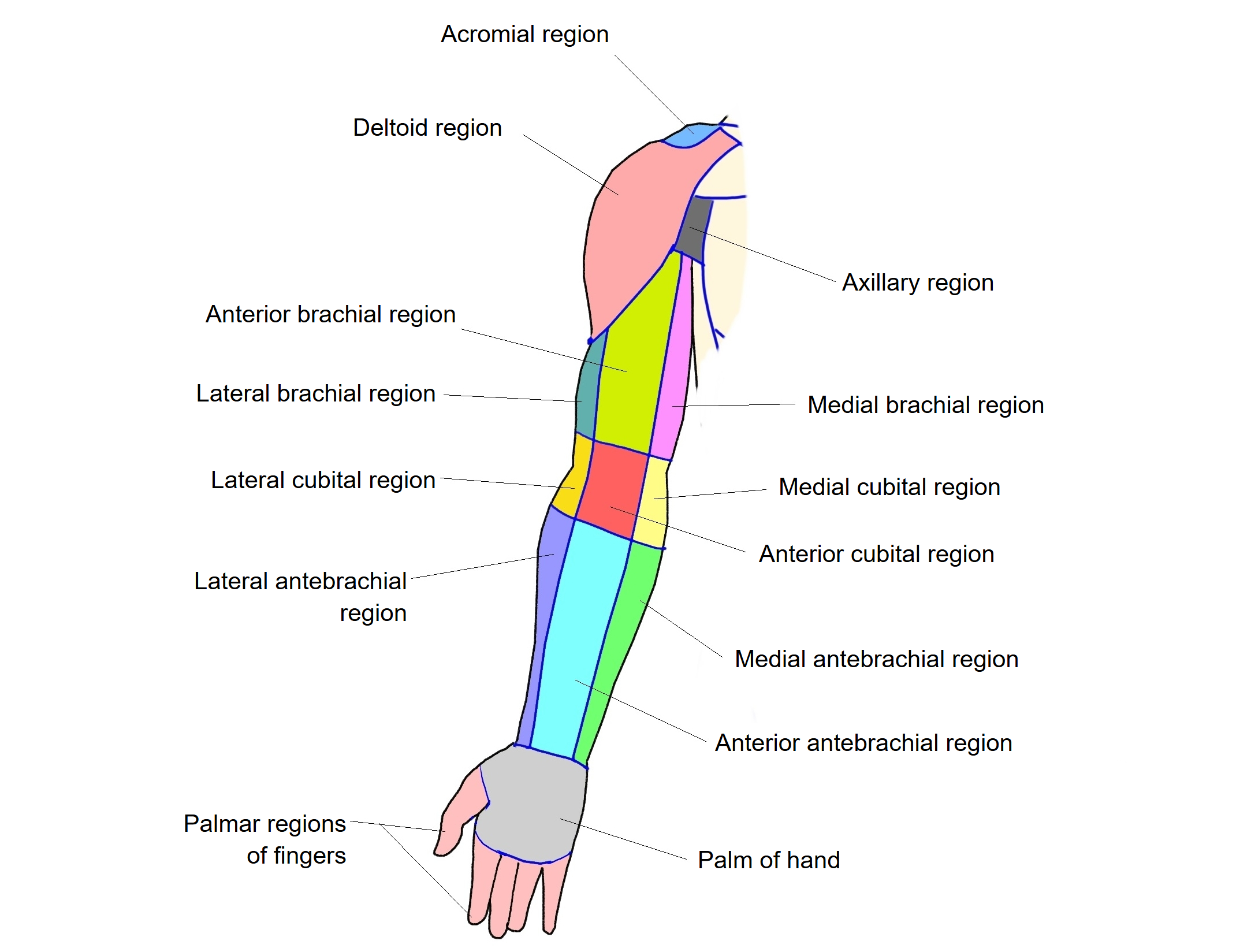
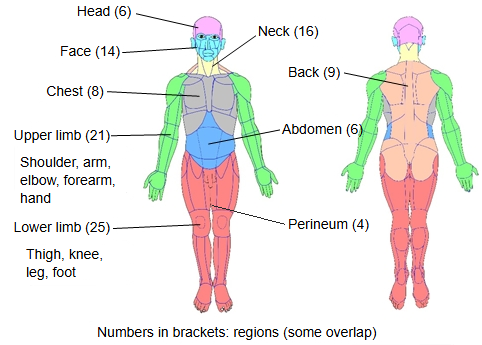
On this site the body is divided into three main parts, the head and neck, the trunk and the limbs, and the limbs into the upper and lower limbs. Each part is divided further into smaller regions (table below).
of the
body
- Head and neck : 1. head (head, face) 2. neck
- Trunk : 1. chest 2. abdomen 3. back
- Limbs
- Upper limb : 1. shoulder 2. arm 3. elbow 4. forearm 5. hand
- Lower limb : 1. perineum 2. thigh 3. knee 4. leg 5. foot
Related terms
- Palm of hand
- Dorsum of hand
- Palmar aponeurosis
- Bones of hand
- Anterior region of elbow
- Medial antebrachial region
References and sources
- Further reading: Finger, Wikipedia.
- Federative International Programme for Anatomical Terminology (FIPAT). Terminologia Anatomica, 2nd ed. (TA2), 2019.