Hamstrings
Also called: hamstring muscles; ischiocrural muscles
The collective name for the muscles on the back of the thigh that run lengthwise: biceps femoris, semitendinosus and semimembranosus.
More detail: "ham" is the back of the thigh (as in the meat), and "strings" refers to the cord-like tendons of these muscles, which can be felt behind the knee on either side; butchers once used these tendons to hang up the legs of pigs. Some sources also count the ischial (hamstring) part of adductor magnus among the hamstrings.
Biceps femoris is called the lateral hamstring, and semimembranosus and semitendinosus the medial hamstrings. Except for the short head of biceps femoris, they all arise from the ischial tuberosity and cross both the hip and the knee; they are supplied by the sciatic nerve.
· The hamstrings have a large effect on the flexibility of the back of the leg: when they are short and stiff, the pelvis cannot tilt forward far while the knee is kept straight.
This limits, for example, bending the trunk forward from standing (or from sitting with the legs straight) and raising a straight leg high in front, as in a high kick.
· They extend the hip joint and flex the knee joint; with the knee bent, biceps femoris rotates the leg laterally, and semitendinosus and semimembranosus rotate it medially. They work hard in fast running and are well developed in sprinters, and for the same reason they are often strained (torn) in sprinting.
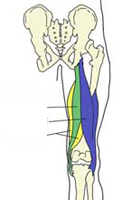 Hamstring muscles (posterior view)
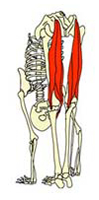 Hamstrings on the skeleton
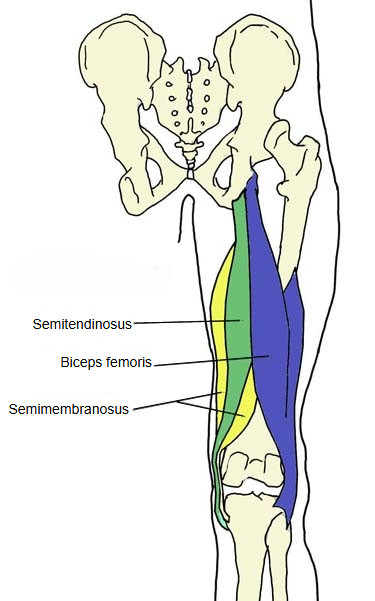
Related terms
- Biceps femoris
- Semitendinosus
- Semimembranosus
- Adductor magnus
- Ischial tuberosity
- Sciatic nerve
- Knee joint
References and sources
- Further reading: Hamstring, Wikipedia.
- Federative International Programme for Anatomical Terminology (FIPAT). Terminologia Anatomica, 2nd ed. (TA2), 2019.