Hook of hamate (Latin: hamulus ossis hamati)
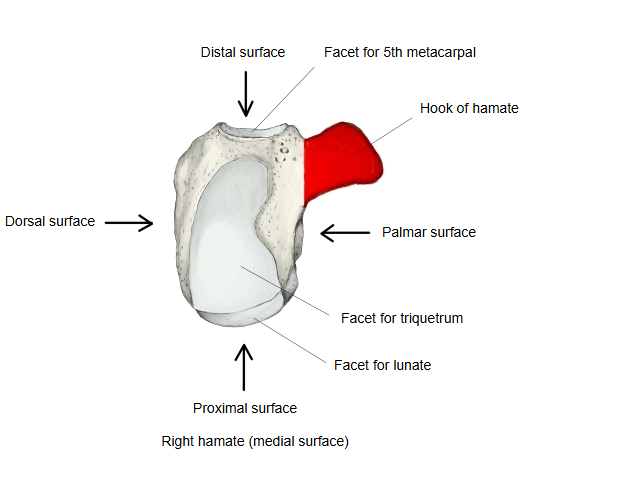
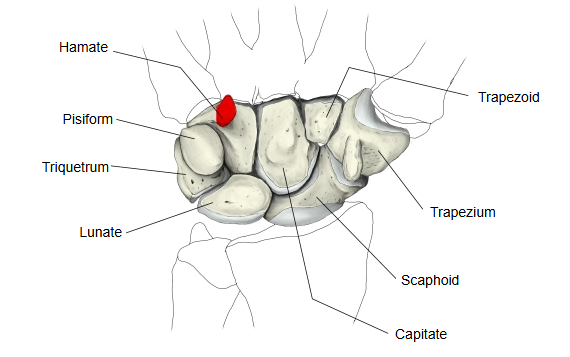
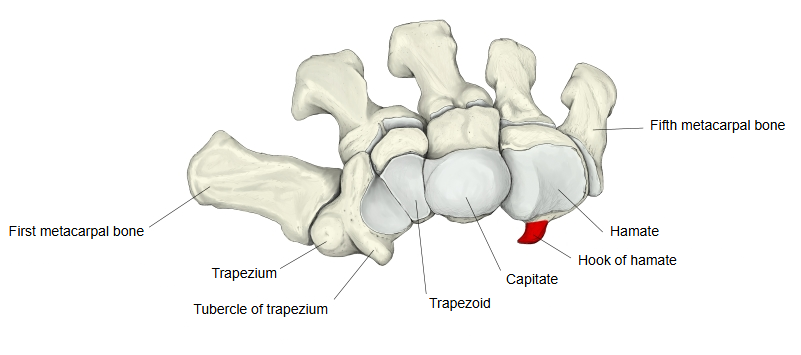
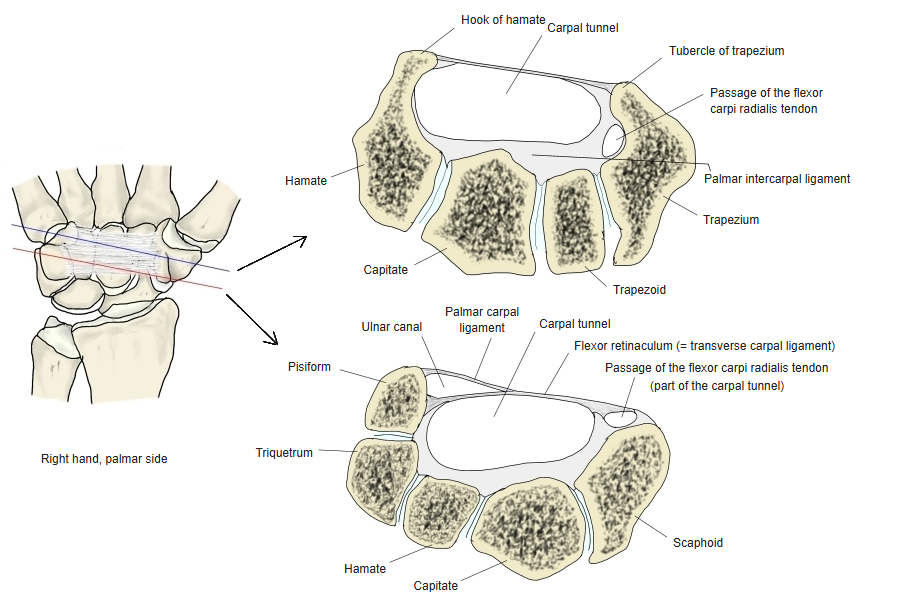
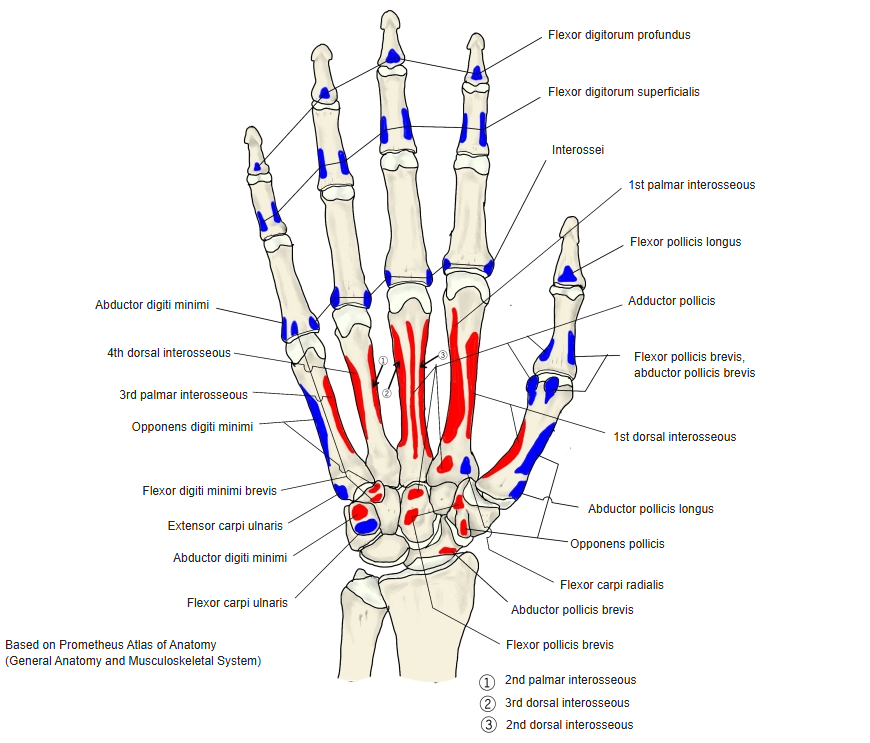
The hook of the hamate is a hooked process on the palmar surface of the hamate, whose tip curves laterally (towards the thumb). The two muscles below arise from it. It is also an attachment of the flexor retinaculum (the transverse carpal ligament), and with the pisiform it forms part of the ulnar (medial) wall of the carpal tunnel.
Note: some sources give the origin of opponens digiti minimi as the hamate in general rather than its hook, while they give the hook of the hamate for flexor digiti minimi brevis. Most sources give the hook for both hypothenar muscles.
The pisohamate ligament runs from the pisiform to the hook. The ulnar nerve and ulnar artery pass close to it in the ulnar canal (Guyon's canal), and the deep branch of the ulnar nerve curves around its lower side. The hook can be felt deep in the hypothenar eminence, distal and lateral to the pisiform. Fractures of the hook occur in golf, racket and baseball players.
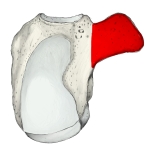 Right hamate (medial)
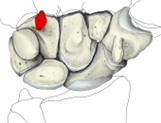 Right carpal bones (palmar)
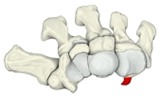 Distal carpal row and metacarpals
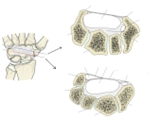 Carpal tunnel (cross-sections)
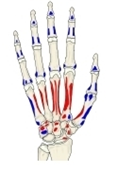 Muscle attachments (palmar)
Reference websites
[Wikipedia]
· Hamate bone, Wikipedia.
· Carpal tunnel, Wikipedia.
[Websites with illustrations]
· The bones of the hand: carpals, metacarpals and phalanges (TeachMeAnatomy)
Where it is found
Related terms
- Hamate
- Carpal tunnel
- Flexor retinaculum (hand)
- Pisiform
- Tubercle of trapezium
- Carpal bones
- Distal carpal row
References and sources
- Further reading: Hamate bone, Wikipedia.
- Further reading: Carpal tunnel, Wikipedia.
- Federative International Programme for Anatomical Terminology (FIPAT). Terminologia Anatomica, 2nd ed. (TA2), 2019.