Carpal bones (Latin: ossa carpi)
Also called the carpals
The eight small bones of the wrist (carpus), lying just distal to the wrist joint (radiocarpal joint) and forming the skeleton of the base of the palm, under the thenar and hypothenar eminences. They lie between the forearm bones (radius and ulna) and the metacarpal bones.
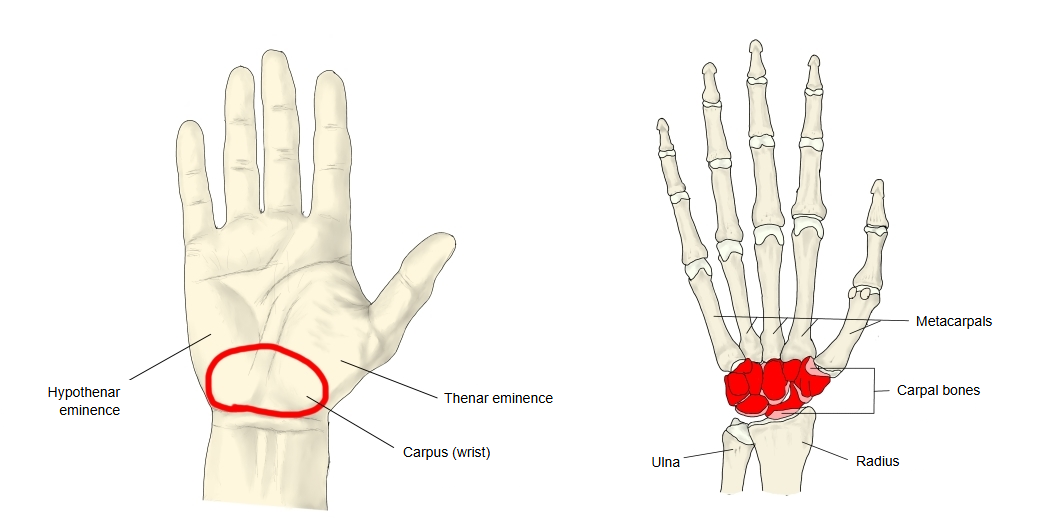
More details
The carpal bones can be thought of as two rows of four bones: the proximal row and the distal row. Each row is listed from the thumb side.
| Distal row | 1 | Trapezium |
| 2 | Trapezoid | |
| 3 | Capitate | |
| 4 | Hamate | |
| Proximal row | 1 | Scaphoid |
| 2 | Lunate | |
| 3 | Triquetrum | |
| 4 | Pisiform |
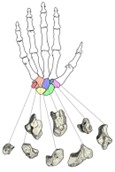 The eight carpal bones
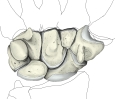 Carpal bones (palmar)
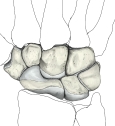 Carpal bones (dorsal)
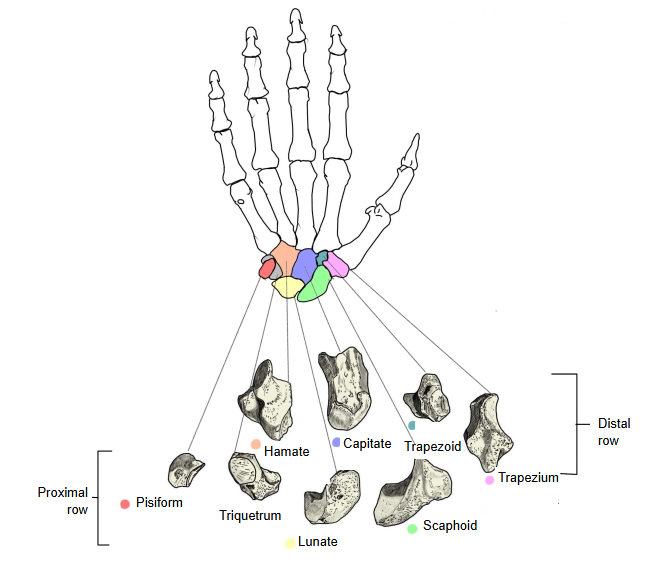
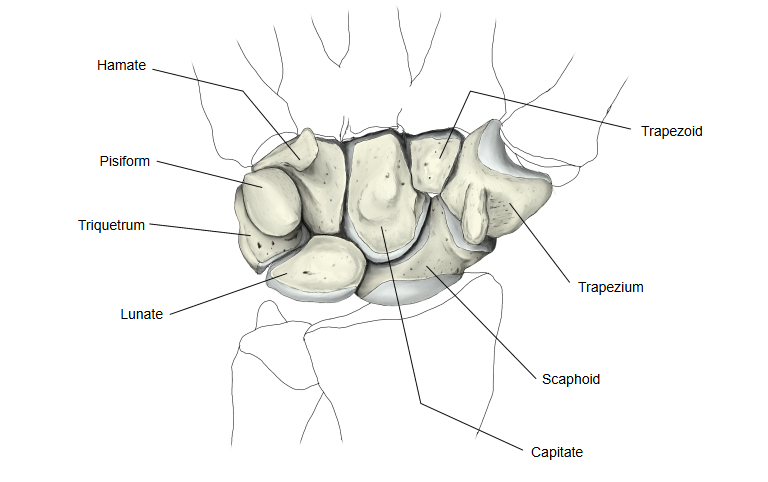
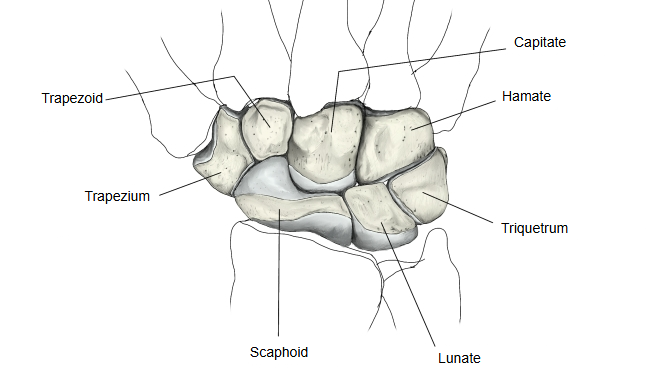
The proximal row (scaphoid, lunate and triquetrum) articulates with the radius and the articular disc at the radiocarpal joint; the pisiform sits on the palmar surface of the triquetrum within the tendon of flexor carpi ulnaris (a sesamoid bone). The two rows meet at the midcarpal joint, and the bones of each row at the intercarpal joints. The distal row articulates with the bases of the five metacarpals at the carpometacarpal joints. The capitate is the largest carpal bone; the hamate carries a hook that can be felt on the palmar side.
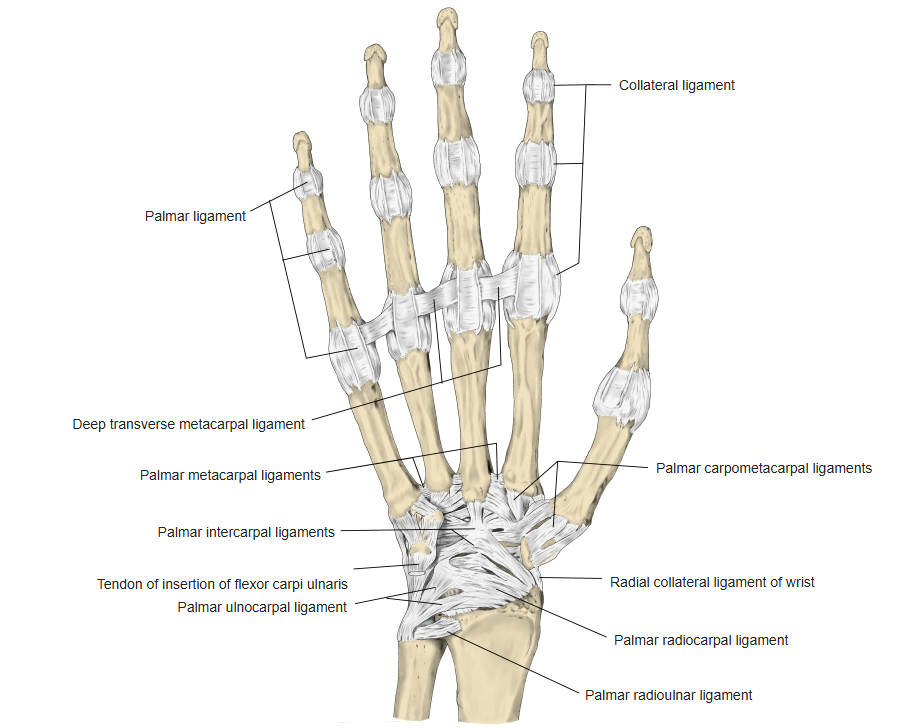
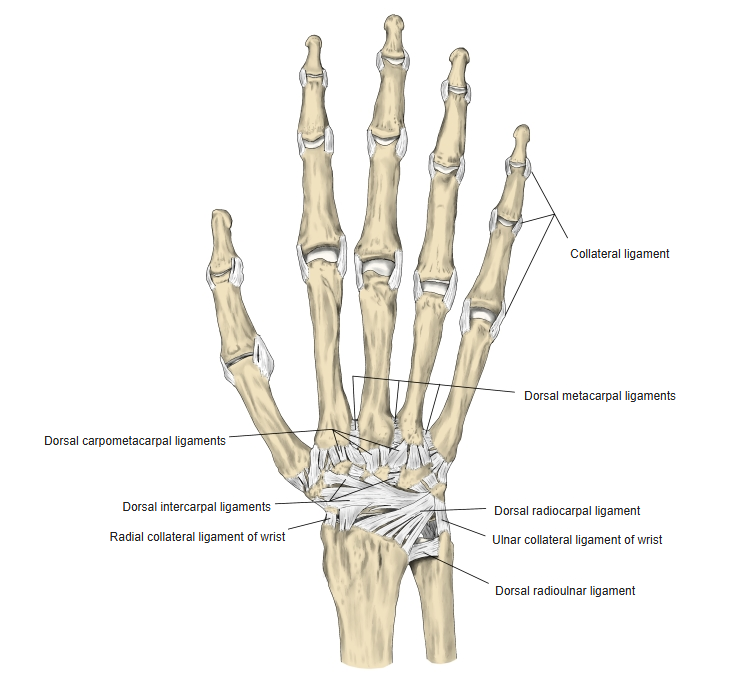
The carpal bones are bound to one another by many palmar, dorsal and interosseous ligaments, so their palmar and dorsal surfaces are rough. Most of the surfaces that face one another, the forearm bones and the metacarpals are smooth and covered with articular cartilage; small rough areas between them are where the ligaments attach. Together the bones form a hollow on the palmar side, which the flexor retinaculum bridges to make the carpal tunnel.
The carpal bones are joined to one another by many ligaments.
Their surfaces facing other bones are covered with articular cartilage.
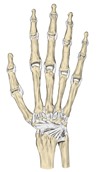 Ligaments, right hand (palmar)
 Ligaments, right hand (dorsal)
Reference websites
[Wikipedia]
· Carpal bones, Wikipedia.
[Websites with illustrations]
· Bones of the hand: carpals, metacarpals and phalanges (TeachMeAnatomy)
· Carpal bones (illustration) (Wikimedia Commons)

Where it is found
Related terms
- Proximal carpal row
- Distal carpal row
- Radiocarpal joint
- Midcarpal joint
- Intercarpal joints
- Carpometacarpal joints
- Carpal tunnel
References and sources
- Further reading: Carpal bones, Wikipedia.
- Federative International Programme for Anatomical Terminology (FIPAT). Terminologia Anatomica, 2nd ed. (TA2), 2019.