Palatine arches
Also called the palatine arch or the faucial pillars
arches
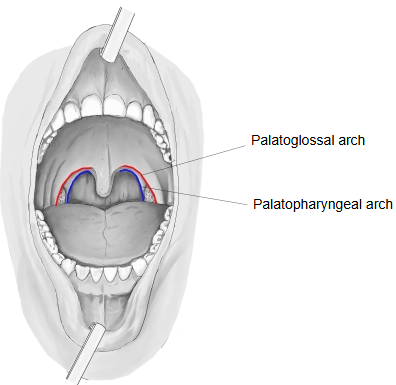
- Palatoglossal arch : the front arch: the palatoglossus covered with mucosa
- Palatopharyngeal arch : the back arch: the palatopharyngeus covered with mucosa
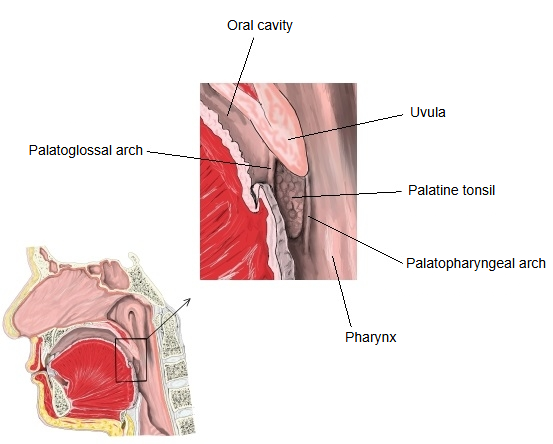
· The hollow between the front and back palatine arches (front: palatoglossal arch; back: palatopharyngeal arch) is the tonsillar fossa, which holds the palatine tonsil.
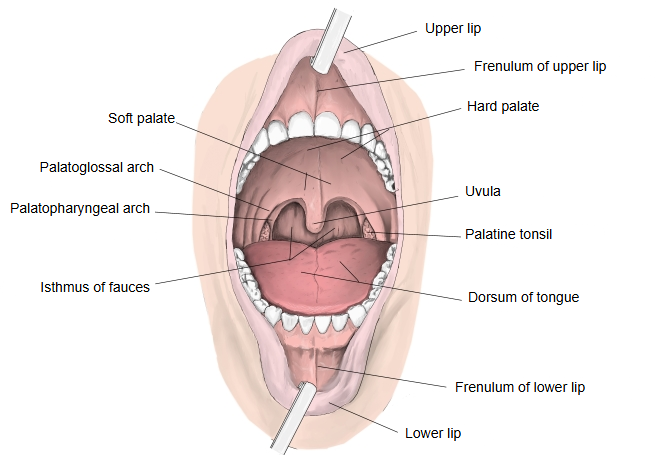
Together with the soft palate and the root of the tongue, the arches bound the isthmus of fauces, the opening from the mouth into the pharynx.
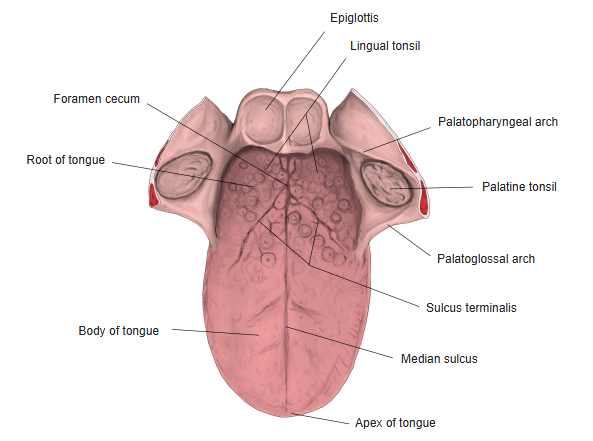
The soft palate extends backwards and downwards from the back edge of the hard palate, and in its middle hangs the uvula. On each side two arched folds pass downwards from the soft palate: these are the palatine arches. The front one, the palatoglossal arch, forms a gentle curve and reaches the side (margin) of the tongue, where it ends in a triangular fold of mucosa (the triangular fold). The back one, the palatopharyngeal arch, curves more steeply, is stretched more narrowly and reaches the side wall of the pharynx.
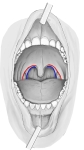 Palatine arches
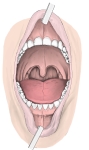 Open mouth, front view
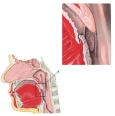 Around the uvula (section)
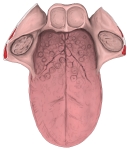 Tongue and palatine arches
Reference websites
[Wikipedia]
· Palatoglossal arch, Wikipedia.
· Palatopharyngeal arch, Wikipedia.
[Websites with illustrations]
· The mouth cavity, with the palatine arches (Gray's Anatomy) (Wikimedia Commons)

· Tongue with the palatoglossal and palatopharyngeal arches (Alamy)

· Oropharynx with the palatine arches and their muscles (Wiley Online Library)

Related terms
- Palatoglossal arch
- Palatopharyngeal arch
- Soft palate
- Palatine tonsil
- Isthmus of fauces
- Palatoglossus
- Palatopharyngeus
References and sources
- Further reading: Palatoglossal arch, Wikipedia.
- Further reading: Palatopharyngeal arch, Wikipedia.
- Federative International Programme for Anatomical Terminology (FIPAT). Terminologia Anatomica, 2nd ed. (TA2), 2019.