Ligamentum arteriosum (Latin: ligamentum arteriosum)
Also called the arterial ligament
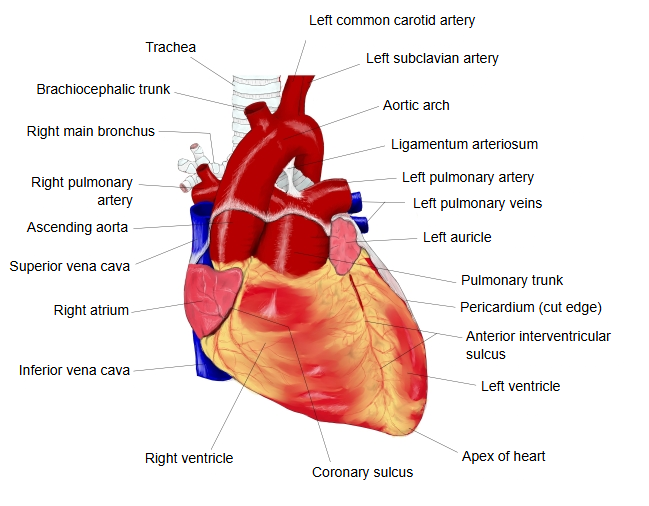
Before birth, the ductus arteriosus carries blood from the pulmonary trunk to the aorta, bypassing the lungs, which are not yet breathing.
Soon after birth the ductus constricts and closes functionally, usually within about a day. Its fibrous (anatomical) closure, by growth of the inner lining, follows over the next days to weeks (sources differ), and only this cord, the ligamentum arteriosum, remains.
· Its upper end attaches to the underside of the aortic arch near the aortic isthmus; its lower end attaches to the start of the left pulmonary artery, close to the bifurcation of the pulmonary trunk.
· The left recurrent laryngeal nerve hooks under the aortic arch just to the left of the ligament, making it a landmark for the nerve.
· If the ductus fails to close, the condition is called patent ductus arteriosus.
Reference websites
[Wikipedia]
· Ligamentum arteriosum, Wikipedia.
· Ductus arteriosus, Wikipedia.
[Websites with illustrations]
· Heart from the front with the ligamentum arteriosum marked (Quora)
· Ligamentum arteriosum in a dissection (photo) (thebodyonline.net)

Related terms
- Aortic arch
- Left pulmonary artery
- Pulmonary trunk
- Recurrent laryngeal nerve
- Heart
- Ligamentum venosum
- Round ligament of liver
References and sources
- Further reading: Ligamentum arteriosum, Wikipedia.
- Further reading: Ductus arteriosus, Wikipedia.
- Federative International Programme for Anatomical Terminology (FIPAT). Terminologia Anatomica, 2nd ed. (TA2), 2019.