Lower limb (Latin: membrum inferius)
Also called the lower extremity
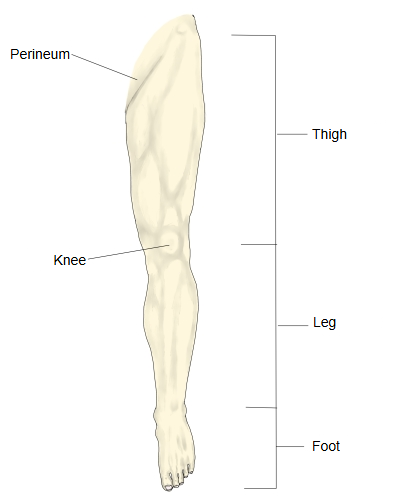
Specifically, it consists of the following parts.
limb
- Perineum : (in the broad sense) the whole outlet of the pelvic floor; listed with the lower limb in some classical texts only.
- Thigh : the part commonly called the thigh, from the root of the limb to the knee.
- Leg : the part from the knee to the ankle (the shin and calf).
- Foot : the part from the ankle to the tips of the toes.
The name "lower limb girdle" (pelvic girdle) is also used; it refers to the hip bone. The skeleton of the free lower limb consists of the femur, patella, tibia, fibula and the bones of the foot; its main joints include the hip joint and the knee joint.
Question
Some classical texts divide the lower limb into four large parts (thigh, leg, foot and perineum) and name the knee, the popliteal fossa and the toes separately. The toes belong to the foot. The knee is usually treated as a region of its own between the thigh and the leg: it has an anterior and a posterior knee region, and the popliteal fossa is the diamond-shaped hollow of the posterior knee region. Smaller regions such as the gluteal region, the hip and the ankle are also named. Most English sources treat the perineal region as a separate region, not as part of the lower limb. See also the list of the muscles of the lower limb and the cross-sections of the lower limb.
 Parts of the lower limb
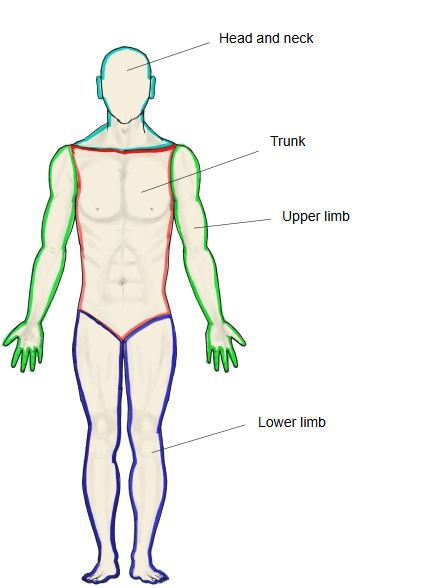
 Main body regions
Related terms
References and sources
- Further reading: Human leg, Wikipedia.
- Federative International Programme for Anatomical Terminology (FIPAT). Terminologia Anatomica, 2nd ed. (TA2), 2019.