Nasal surface of perpendicular plate (Latin: facies nasalis laminae perpendicularis ossis palatini)
Also called: medial surface of perpendicular plate
· Also called the medial surface.
bone
- Perpendicular plate : a vertical plate of bone with 2 surfaces (nasal and maxillary) and 3 processes.
- Orbital process : projects upwards and laterally from the upper end of the perpendicular plate; forms a very small part of the orbit.
- Sphenoidal process : projects upwards and medially from the upper end of the perpendicular plate; meets the sphenoid bone.
- Pyramidal process : projects backwards and laterally from the lower end of the bone, where the two plates meet.
- Horizontal plate : a horizontal plate of bone with 2 surfaces (nasal surface = upper; palatine surface = lower).
dicular
plate
- Nasal / medial surface : forms the back part of the lateral wall of the nasal cavity; two ridges (ethmoidal crest and conchal crest).
- Maxillary / lateral surface : joins the maxilla (palatomaxillary suture).
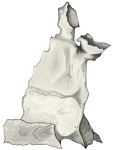 Palatine bone (nasal surface)
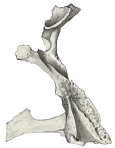 Right palatine bone (posterior view)
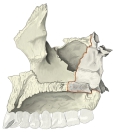 Maxilla and palatine bone (medial view)
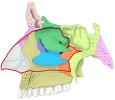 Nasal cavity (lateral wall)
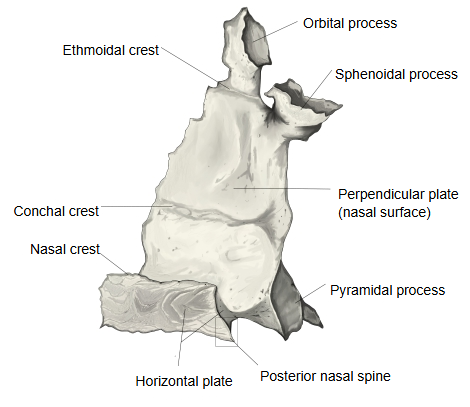
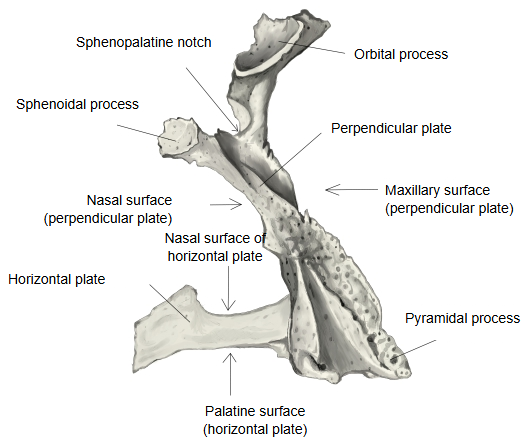
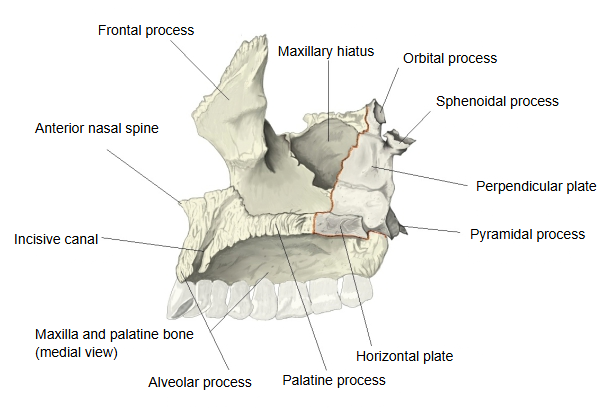
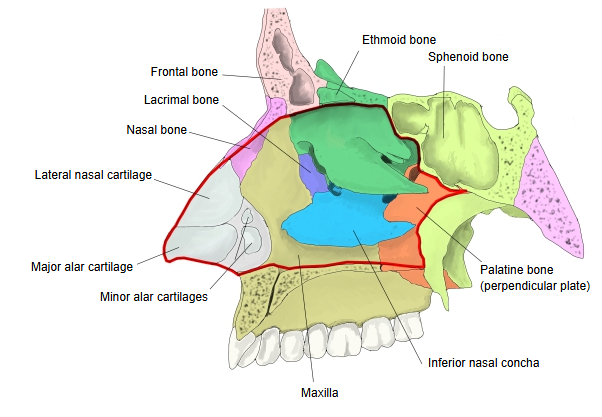
The medial surface forms the back part of the lateral wall of the nasal cavity. Two ridges run across it from front to back: the upper ethmoidal crest, for the back end of the middle nasal concha, and the lower, well-developed conchal crest, for the inferior nasal concha. The upper border of the plate is deeply cut by the sphenopalatine notch; the body of the sphenoid bone above closes it into the sphenopalatine foramen, which connects the nasal cavity with the pterygopalatine fossa. In front of the notch rises the larger orbital process, which touches the maxilla, ethmoid and sphenoid and forms the very back of the floor of the orbit; behind it the smaller sphenoidal process runs upwards and medially under the body of the sphenoid bone, reaching the ala of the vomer; with the vaginal process of the sphenoid it encloses the palatovaginal (pharyngeal) canal.
Reference websites
[Wikipedia]
· Perpendicular plate of palatine bone, Wikipedia.
· Palatine bone, Wikipedia.
[Websites with illustrations]
· Palatine bone: plates, borders, processes, articulations (Kenhub)
Related terms
- Perpendicular plate
- Maxillary surface of perpendicular plate
- Conchal crest
- Orbital process
- Sphenopalatine notch
- Sphenopalatine foramen
- Palatine bone
References and sources
- Further reading: Perpendicular plate of palatine bone, Wikipedia.
- Federative International Programme for Anatomical Terminology (FIPAT). Terminologia Anatomica, 2nd ed. (TA2), 2019.