Pyramidal process (Latin: processus pyramidalis ossis palatini)
Also called the pyramidal process of palatine bone
of the
palatine bone
- Orbital process : projects upwards, forwards and laterally from the upper end of the perpendicular plate and forms part of the back of the floor of the orbit.
- Sphenoidal process : projects upwards and medially from the back of the upper border of the perpendicular plate and forms part of the roof and lateral wall of the nasal cavity.
- Pyramidal process : projects backwards and laterally from the lower back part of the perpendicular plate and fits into the pterygoid notch of the sphenoid bone.
· Wikipedia describes its posterior and lateral surfaces. A summary follows; see the article in the references for details.
Posterior surface: in the middle is a smooth triangular groove running from top to bottom, which forms the lower part of the pterygoid fossa and gives origin to a few fibres of medial pterygoid (its deep head).
On each side of the groove is a rough strip that joins the pterygoid process (sphenoid bone). ⇒ Illustration
Lateral surface: its front part is rough, because it joins the tuberosity of the maxilla (maxillary tuberosity); its back part is a smooth triangle that completes the lower part of the infratemporal fossa. The superficial head of medial pterygoid arises from this surface and the maxillary tuberosity.
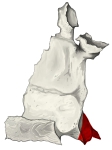 Palatine bone (nasal surface)
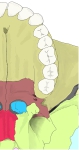 Hard palate and pterygoid plates (inferior)
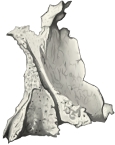 Palatine bone (maxillary surface)
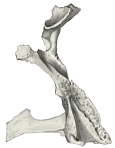 Palatine bone (posterior)
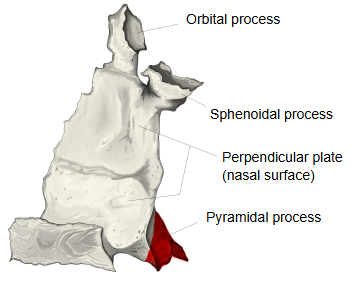
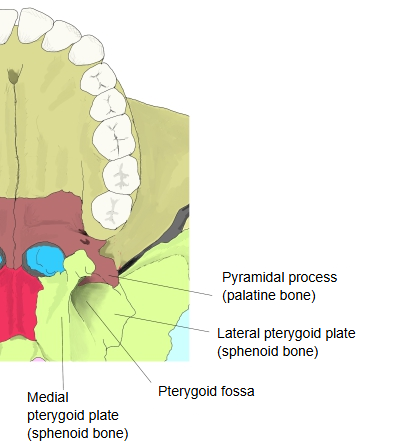
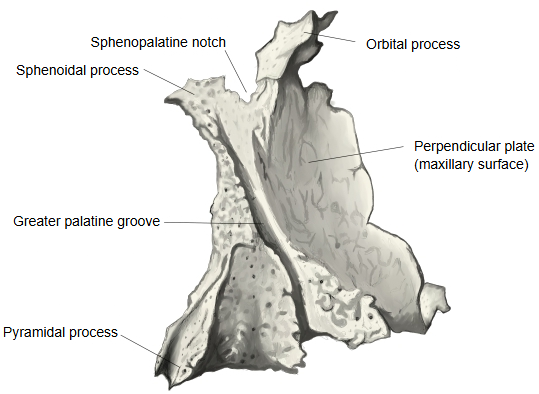
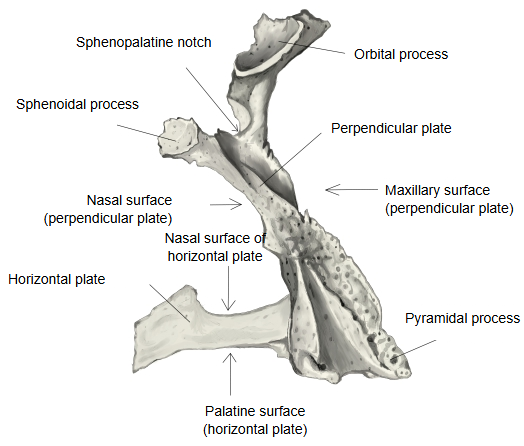
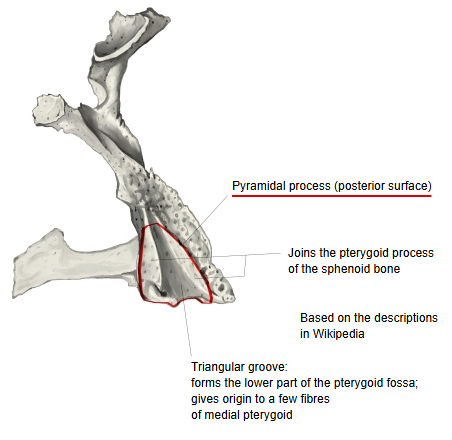
The perpendicular plate and the pyramidal process
The perpendicular plate of the palatine bone is thin. In front it overlaps the medial surface of the body of the maxilla and covers part of the opening of the maxillary sinus (maxillary hiatus) from behind and below. Behind, it meets the pterygoid process of the sphenoid bone. Where it turns into the horizontal plate, the pyramidal process projects backwards and fits into the pterygoid notch, the gap at the lower end of the pterygoid fossa between the lateral and medial plates of the pterygoid process.
Near the base of the pyramidal process, close to the horizontal plate, lie the lesser palatine foramina, which carry the lesser palatine nerves and vessels to the soft palate.
Reference websites
[Wikipedia]
· Pyramidal process of palatine bone, Wikipedia.
· Palatine bone, Wikipedia.
[Websites with illustrations]
· Left palatine bone, posterior aspect (Gray's Anatomy, fig. 169) (Wikimedia Commons)

· Left palatine bone, nasal aspect (Gray's Anatomy, fig. 168) (Wikimedia Commons)

Where it is found
Related terms
- Perpendicular plate
- Horizontal plate
- Orbital process
- Sphenoidal process
- Pterygoid process
- Maxillary tuberosity
- Palatine bone
References and sources
- Further reading: Pyramidal process of palatine bone, Wikipedia.
- Further reading: Palatine bone, Wikipedia.
- Federative International Programme for Anatomical Terminology (FIPAT). Terminologia Anatomica, 2nd ed. (TA2), 2019.