Neck of pancreas (Latin: collum pancreatis)
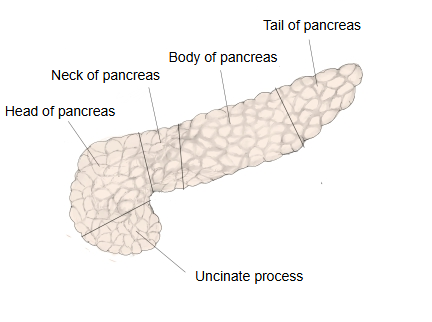
· The name is listed in Terminologia Anatomica (collum pancreatis), but many textbooks give no separate description of the neck.
The neck is the short, narrow part of the pancreas between the head and the body. It is about 2 cm long and lies in front of the first lumbar vertebra, slightly to the left of the head.
Position and structure
Relations in front and behind
In front: the pyloric part of the stomach, separated from it by the omental bursa (lesser sac); its front surface is covered by peritoneum.
Behind: the portal vein and the superior mesenteric vein pass behind the neck.
Behind the neck, the superior mesenteric vein joins the splenic vein to form the portal vein, so this is an important crossing point of large vessels.
Clinical significance
The neck is an important surgical landmark.
Because it is narrow and lies over the portal vein, it is the usual place where the pancreas is divided in a pancreaticoduodenectomy (Whipple operation).
Because large vessels lie around the neck, a pancreatic cancer here is likely to invade the vessels early.
Most sources divide the pancreas into four parts, the head, neck, body and tail; some name only three (head, body and tail) and count the neck as part of the head or body.
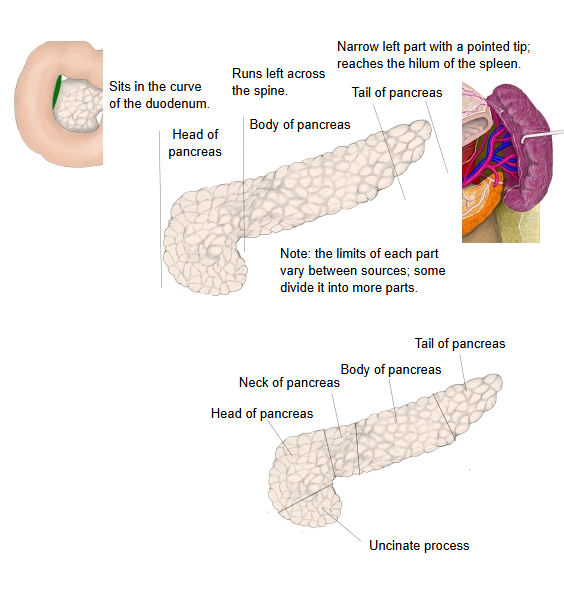
pancreas
- Head : the swollen right end, fitted into the C-shaped curve of the duodenum. Term: uncinate process (the part projecting below).
- Body : runs to the left across the front of the vertebral column; three surfaces and three borders are distinguished.
- Anterior surface : faces forward and upward, toward the back of the stomach across the omental bursa. Covered by parietal peritoneum.
- Posterior surface : flat; attached directly to the abdominal wall by loose connective tissue. Not covered by parietal peritoneum.
- Inferior surface : very narrow; faces forward and downward. Sometimes absent. Covered by parietal peritoneum.
- Anterior, superior and inferior borders : the anterior border is slightly sharp and gives attachment to the transverse mesocolon; the superior and inferior borders are blunt.
- Tail : the narrow part reaching farthest to the left; its tip is pointed and reaches about the middle of the visceral surface of the spleen, at its hilum.
Note: some sources divide the pancreas into five parts, adding two more to the three above: the neck (a short narrow part joining the head to the body, in front of the portal vein) and the uncinate process. Most texts use four parts (head, neck, body and tail).
Reference websites
[Wikipedia]
· Pancreas, Wikipedia.
[Websites with illustrations]
· Parts of the pancreas (figure) (TeachMeAnatomy)
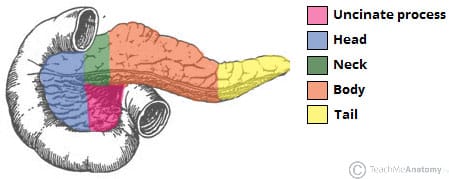
· The pancreas (TeachMeAnatomy)
Where it is found
Related terms
- Head of pancreas
- Body of pancreas
- Tail of pancreas
- Pancreas
- Portal vein
- Superior mesenteric vein
- Splenic vein
References and sources
- Further reading: Pancreas, Wikipedia.
- Federative International Programme for Anatomical Terminology (FIPAT). Terminologia Anatomica, 2nd ed. (TA2), 2019.