Endoneurium (Latin: endoneurium)
Also called the endoneurial sheath or the sheath of Henle
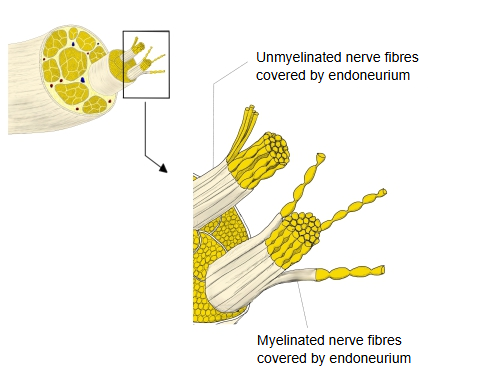
The endoneurium is the membrane of loose connective tissue that wraps each individual nerve fibre of the peripheral nervous system.
Both unmyelinated and myelinated nerve fibres (axon + myelin sheath)Mainly collagen fibres
The main component of the endoneurium is collagen fibres; between the fibres lie the other components listed below.
Collagen has many types; here they are mostly type I and type III
Make-up
of the
endoneurium
of the
endoneurium
- Collagen fibres : mainly type I and type III; the most abundant component, giving structural support.
- Fibroblasts : make and maintain the collagen.
- Capillaries : a network of long capillaries; supply nutrients and oxygen and remove waste.
- Immune cells : macrophages, mast cells and others; repair after inflammation or injury and dispose of foreign matter.
- Basement membrane : the basal lamina of the Schwann cells, between the nerve fibres and the connective tissue; protection and barrier.
- Ground substance : water and sugar-protein molecules; forms the extracellular matrix and takes part in the movement of substances.
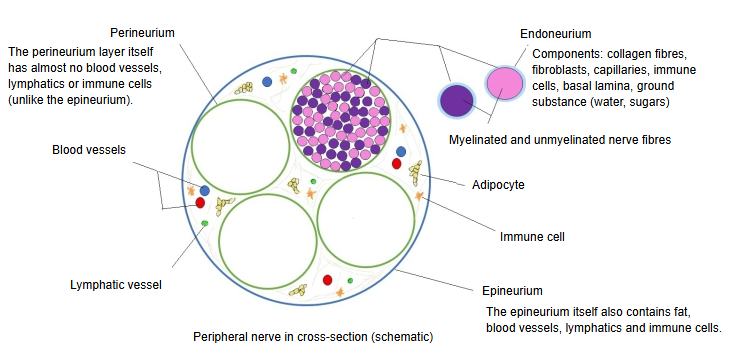
The group of nerve fibres wrapped by the endoneurium is bundled into a fascicle by a membrane called the perineurium, and the fascicles are bundled further by the epineurium.
Usually a mixture of myelinated and unmyelinated fibresFrom hundreds to thousands of fibres
Coverings
of a
peripheral
nerve
of a
peripheral
nerve
- Endoneurium : a membrane of loose connective tissue (mainly collagen fibres) that covers each unmyelinated and myelinated nerve fibre one by one. Components: collagen fibres, capillaries, immune cells, basement membrane, ground substance (water, sugars).
- Perineurium : bundles many nerve fibres (from tens to thousands) into a fascicle; made of flattened perineurial cells joined tightly in several to more than ten layers, with thin layers of collagen fibres between them (many sources therefore class it as dense connective tissue). It has almost no lymphatic vessels or immune cells.
- Epineurium : the outermost covering of a peripheral nerve, bundling the fascicles (from a few to dozens) wrapped by the perineurium. Components: irregular dense connective tissue, adipose tissue, blood vessels, lymphatic vessels and immune cells.
Some sources call these coverings together (sometimes without the endoneurium) the nerve sheath.
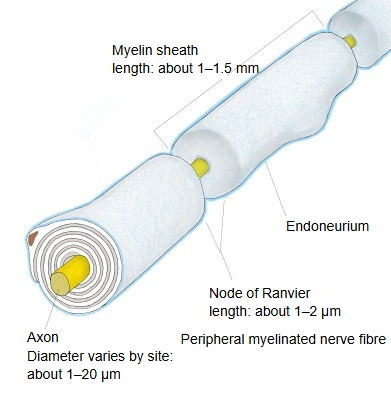
The endoneurium lies directly on the basal lamina of the Schwann cells. It runs along the whole length of each fibre and also covers the nodes of Ranvier.
It is bathed in endoneurial fluid, which is low in protein and plays a role similar to that of the cerebrospinal fluid in the central nervous system. After a nerve injury this fluid increases, which helps to locate the injury on magnetic resonance neurography.
After a nerve is cut, the endoneurial tubes and their Schwann cells guide the regrowing axons.
 Myelinated nerve fibre and endoneurium
 Endoneurium
Reference websites
[Wikipedia]
· Endoneurium, Wikipedia.
· Nerve, Wikipedia.
Related terms
- Perineurium
- Epineurium
- Nerve fibre
- Nerve sheath
- Node of Ranvier
- Unmyelinated nerve fibre
- Fibrofatty tissue
- Collagen fiber
- Reticular fibres
- Basement membrane
- Peripheral nervous system
References and sources
- Further reading: Endoneurium, Wikipedia.
- Further reading: Nerve, Wikipedia.
- Federative International Programme for Anatomical Terminology (FIPAT). Terminologia Anatomica, 2nd ed. (TA2), 2019.