Olfactory vesicle
Also called the olfactory knob or the dendritic knob
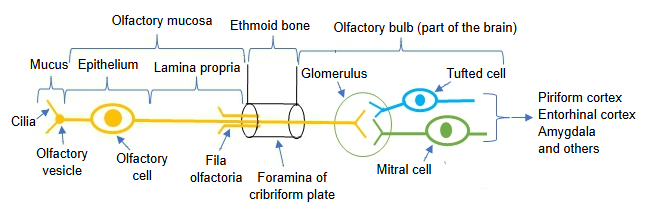
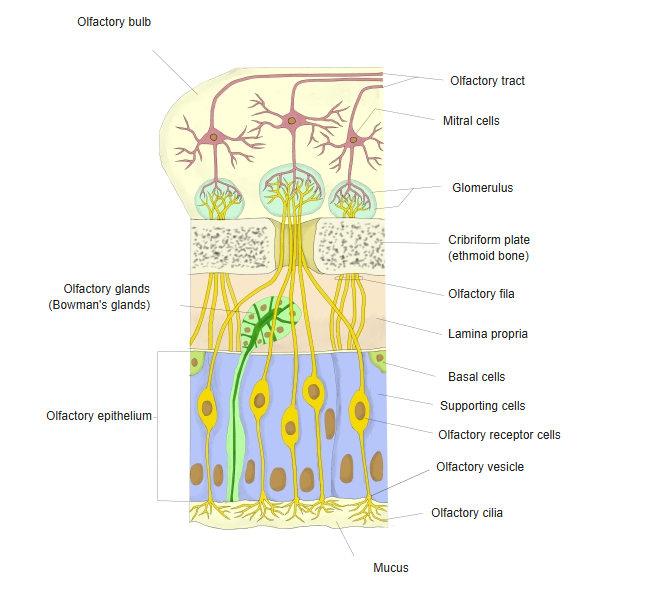
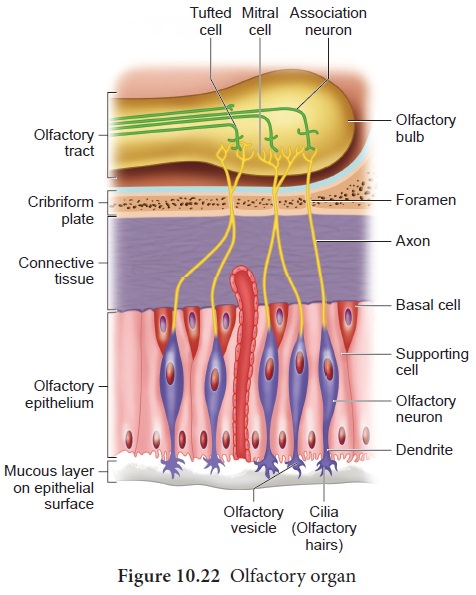
The olfactory vesicle is the swelling at the tip of the dendrite of an olfactory cell that faces the nasal cavity; it sends a tuft of long olfactory cilia into the mucus layer.
Olfactory cell: the nerve cell in the olfactory part of the nasal mucosa (the olfactory epithelium)The odorant receptors lie in the membrane of the cilia, so this is where odours are first detected. Sources differ on the number of cilia on each vesicle; figures from about 6 up to about 30 are given
· Each olfactory cell is a bipolar neuron: a single dendrite runs to the surface of the olfactory epithelium and ends in the vesicle, while the axon runs the other way, through the cribriform plate of the ethmoid bone as the fila olfactoria, to the olfactory bulb.
· The cilia are long and non-motile and spread out in the mucus. The mucus around them comes mainly from the olfactory glands (Bowman's glands) in the lamina propria.
Reference websites
[Wikipedia]
· Olfactory receptor neuron, Wikipedia.
[Websites with illustrations]
· Olfactory organ: olfactory vesicle, cilia and olfactory neurons (BrainKart)
Related terms
- Mucus
- Cilia
- Olfactory receptor cells
- Olfactory epithelium
- Nasal mucosa
- Olfactory glands
- Fila olfactoria
- Olfactory bulb
References and sources
- Further reading: Olfactory receptor neuron, Wikipedia.
- Federative International Programme for Anatomical Terminology (FIPAT). Terminologia Anatomica, 2nd ed. (TA2), 2019.