Optic axis (Latin: axis opticus)
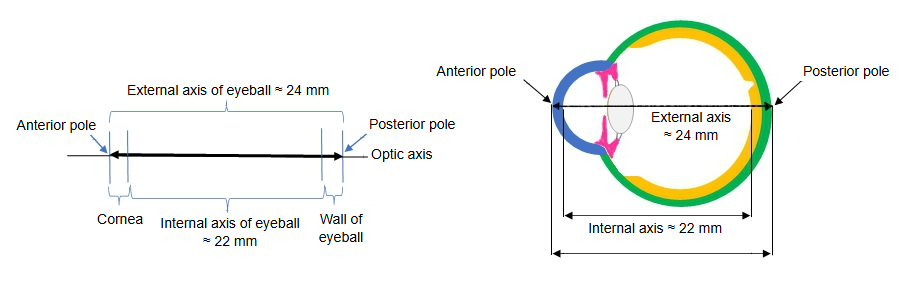
The optic axis is the straight line that passes through the two points of the eyeball, the anterior pole and the posterior pole; the internal and external axes of the eyeball are measured along it.
Anterior pole: the frontmost point of the eyeball, at the centre of the front surface of the corneaPosterior pole: the backmost point of the eyeball, between the optic disc and the fovea centralis
· Some sources treat the optic axis as the same line as the visual axis.
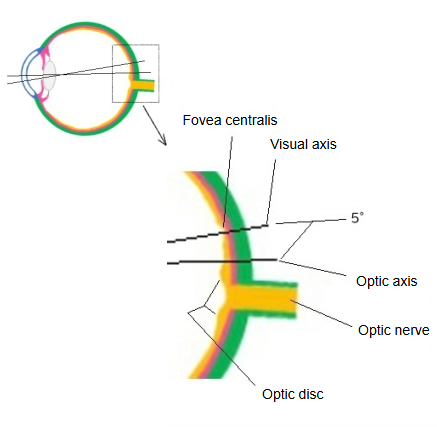
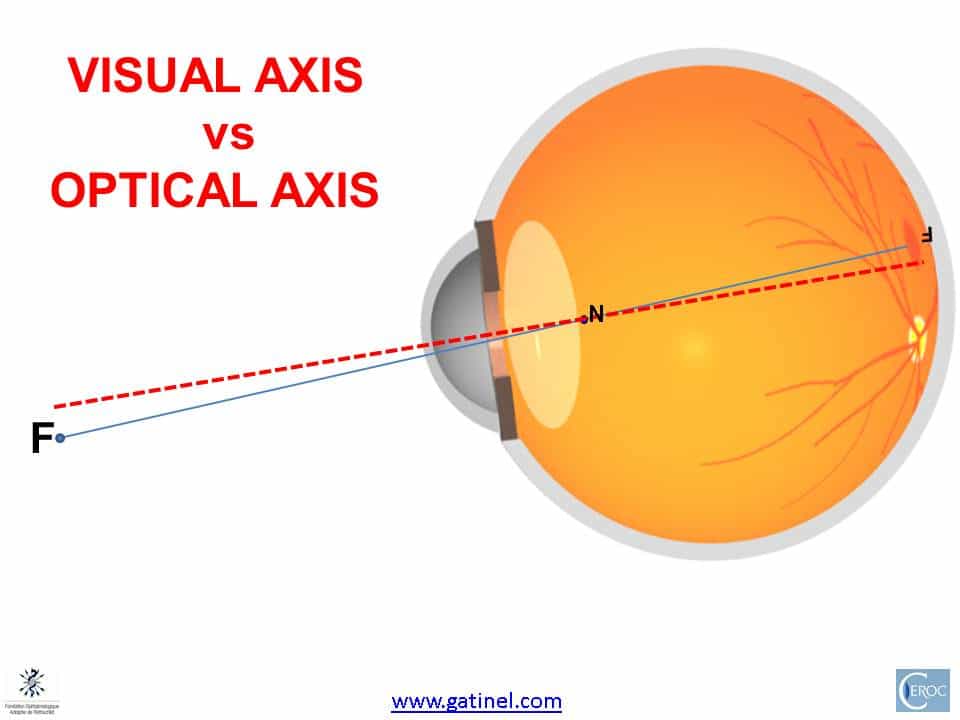
Strictly, the optic axis passes through the centres of the cornea and the lens and meets the back wall of the eye between the optic disc and the fovea centralis of the macula lutea. The visual axis (line of sight) runs from the point being looked at to the fovea centralis; the two lines are about 5 degrees apart.
Reference websites
[Wikipedia]
· Optical axis, Wikipedia.
· Human eye, Wikipedia.
[Websites with illustrations]
· Visual axis vs optical axis (figure) (Gatinel)
· Optical axis and visual axis (figure) (SPIE)

· Visual axis, optical axis and pupil axis (figure) (Healio)

· Optical and visual axes of both eyes (figure) (Optics & Photonics News)

Related terms
References and sources
- Further reading: Optical axis, Wikipedia.
- Further reading: Human eye, Wikipedia.
- Federative International Programme for Anatomical Terminology (FIPAT). Terminologia Anatomica, 2nd ed. (TA2), 2019.