Posterior pole of eyeball (Latin: polus posterior bulbi oculi)
The posterior pole is the point of the eyeball that projects furthest backwards; it is the back end of the external axis of the eyeball.
External axis: the line joining the anterior pole and the posterior pole, about 24 mm
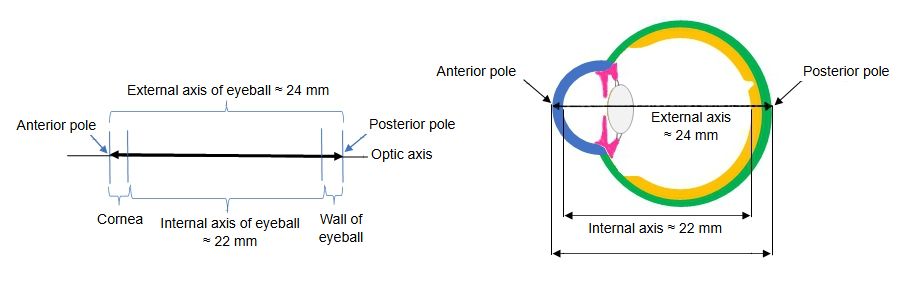
The posterior pole lies on the sclera, directly opposite the anterior pole, the centre of the front of the cornea. The optic axis also passes close to it. The optic nerve does not leave the eyeball at the pole but a few millimetres to its medial (nasal) side; on the inner surface, the macula lutea lies at or very close to the pole. The equator of the eyeball is the great circle midway between the two poles; the meridians run from pole to pole.
Related terms
References and sources
- Further reading: Human eye, Wikipedia.
- Federative International Programme for Anatomical Terminology (FIPAT). Terminologia Anatomica, 2nd ed. (TA2), 2019.