Pes anserinus (Latin: pes anserinus)
Also called: goose's foot, superficial pes anserinus
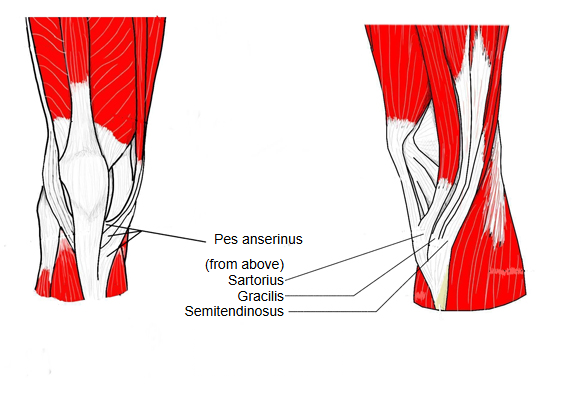
The pes anserinus is the combined insertion of the tendons of sartorius, gracilis and semitendinosus on the upper end of the medial surface of the tibia. The flattened tendons also blend with the fascia lata of the thigh and the deep fascia of the leg, forming a web-like sheet that looks like the webbed foot of a water bird, hence the name (goose's foot).
From front to back (and from above down) the three tendons are sartorius, gracilis and semitendinosus. They attach medial to the tibial tuberosity, below the medial condyle. They lie superficial to the tibial collateral ligament of the knee joint; the anserine bursa separates them from it. The three muscles come from three different compartments of the thigh and have three different nerves (femoral, obturator and tibial). All three flex the knee and medially rotate the flexed leg.
Some texts call the insertion of semimembranosus the "deep pes anserinus"; the term usually means only the superficial insertion of the three tendons.
Reference websites
[Wikipedia]
· Pes anserinus (leg), Wikipedia.
Related terms
- Sartorius
- Gracilis
- Semitendinosus
- Tibia
- Medial condyle of tibia
- Tibial collateral ligament
- Knee joint
References and sources
- Further reading: Pes anserinus (leg), Wikipedia.
- Federative International Programme for Anatomical Terminology (FIPAT). Terminologia Anatomica, 2nd ed. (TA2), 2019.