Pharyngeal lymphoid ring (Latin: anulus lymphoideus pharyngis)
Also called Waldeyer's ring or Waldeyer's tonsillar ring
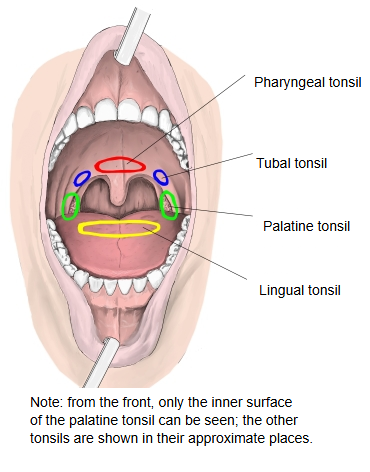
The four tonsils of the pharynx, the pharyngeal tonsil, the tubal tonsils, the palatine tonsils and the lingual tonsil, are arranged in a ring around its upper part, where the airway and the food passage begin. The ring is named after the German anatomist who described it, Heinrich Wilhelm Gottfried von Waldeyer-Hartz: Waldeyer's (tonsillar) ring.
The unpaired pharyngeal tonsil lies on the roof and back wall of the nasopharynx; the paired tubal tonsils lie around the openings of the auditory tubes; the paired palatine tonsils lie between the palatine arches; and the lingual tonsil lies on the root of the tongue. Smaller patches of lymphoid tissue in the pharyngeal wall fill the gaps between them. Lying at the entrance to the respiratory and digestive tracts, the ring meets inhaled and swallowed antigens early and is part of the mucosa-associated lymphoid tissue.
Reference websites
[Wikipedia]
· Waldeyer's tonsillar ring, Wikipedia.
[Websites with illustrations]
· Waldeyer ring (Radiopaedia)
· Tonsils (Kenhub)
Related terms
References and sources
- Further reading: Waldeyer's tonsillar ring, Wikipedia.
- Federative International Programme for Anatomical Terminology (FIPAT). Terminologia Anatomica, 2nd ed. (TA2), 2019.